
Updated August 8, 2026 | Technical claims checked against the 3GPP Type 0 SMS specification, current mobile-security research, and official Apple and Google location guidance.
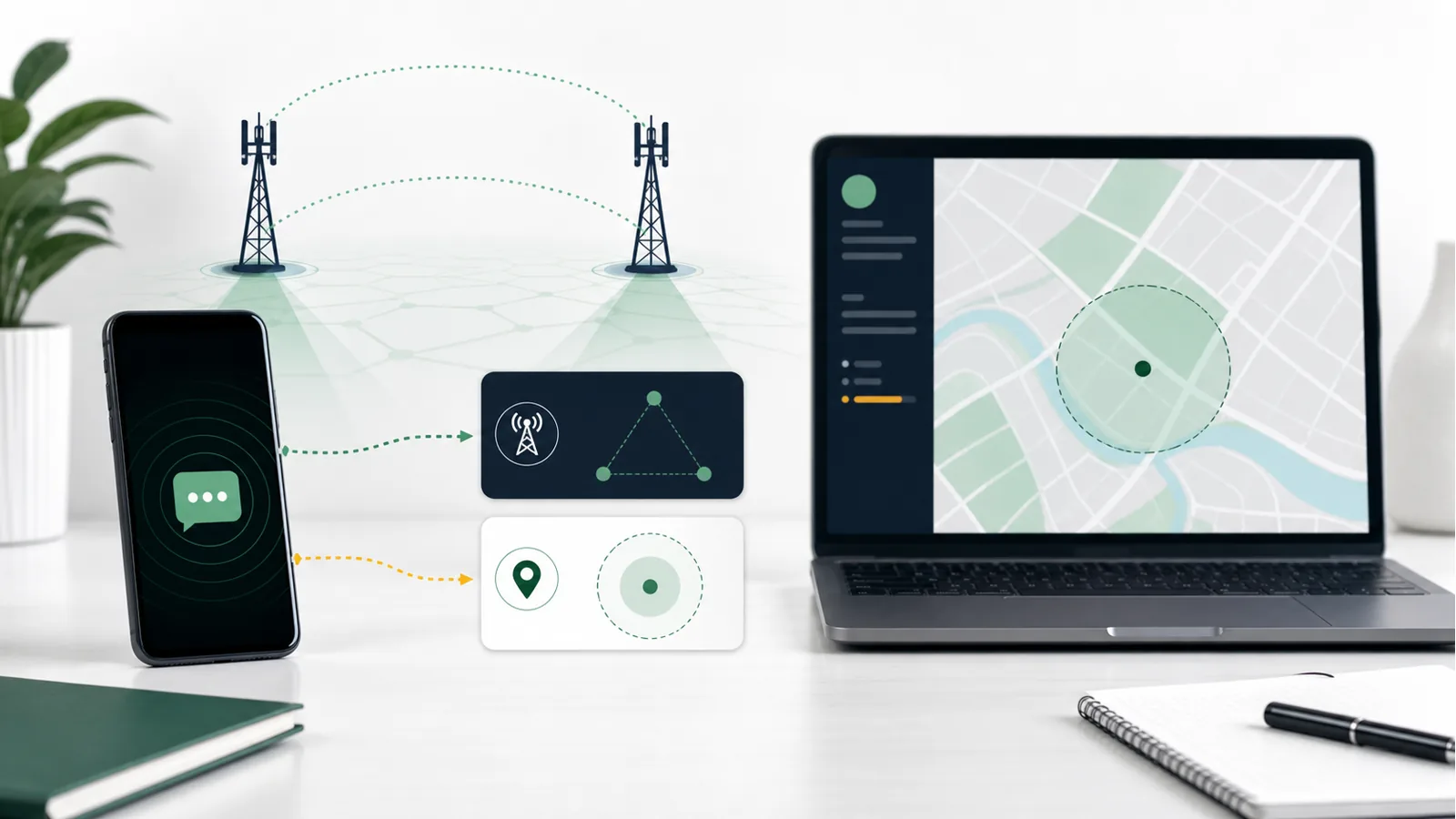
Silent SMS location tracking is real as a telecom and security concept, but it is widely misrepresented. A silent SMS can make a phone acknowledge a network message without showing it in the normal inbox. It does not make the phone send its GPS coordinates back to any person who knows the number.
This guide explains what a Type 0 SMS actually does, who may have enough network access to use the resulting metadata, how accurate location inference can be, and which consumer location tools work when you need to find your own phone or supervise a family device.
Silent SMS tracking: the quick verdict
What is a silent SMS or Type 0 SMS?
A silent SMS is a specially formatted Short Message Type 0. Under the 3GPP specification, the mobile equipment acknowledges receipt but may discard the contents. The handset does not normally store the message in the usual SMS inbox or alert the user.
The acknowledgement matters because delivering any mobile message involves the carrier network. The network knows enough about the device’s registration area to route the message. Investigators with lawful access to carrier records may use a silent message to trigger fresh signalling, then examine cell-site information held by the network.
That is different from a consumer sending an ordinary SMS. A normal sender may receive a delivery report, but does not receive the carrier’s cell-tower records, subscriber identifiers, or an exact map pin.
Correction to a common claim: the phone does not silently reply to the sender with its GPS location. The useful data comes from network signalling, carrier records, specialized radio observation, or statistical inference. Those are separate capabilities.
Can silent SMS reveal an exact GPS location?
Not by itself. A Type 0 message contains no magic request for GPS coordinates. It can prompt network activity, but the resulting location depends on what other data and access are available.
- Carrier or authorized investigator: may correlate the event with the cell serving the phone and other network measurements. This can provide an approximate area and, in some systems, a more refined network estimate.
- Security researcher: may study delivery timing or observe radio traffic under controlled conditions. Research has shown that repeated measurements and trained models can distinguish previously profiled locations, but this is not the same as receiving an arbitrary live GPS pin.
- Ordinary SMS sender: receives, at most, standard delivery information offered by the carrier or messaging app. That does not include the recipient’s cell site or GPS coordinates.
- Installed phone app: may obtain GPS, Wi-Fi, or cell-based location if the app is installed, configured, and granted the necessary location access. The app is doing the location work, not the silent SMS itself.
How accurate is silent SMS location tracking?
There is no single accuracy figure. “Silent SMS tracking” can describe several very different systems, and their output ranges from a broad network area to a precise app-generated GPS point.
| Method | What it can reveal | Typical limitation |
|---|---|---|
| Type 0 SMS alone | Confirmation that the message reached an active device. | No consumer GPS coordinates or map pin. |
| Carrier cell-site records | The serving cell or a network-estimated area. | Accuracy varies with tower density, network design, terrain, and legal access. |
| SMS timing research | A probability that a device is at one of several previously measured locations. | Requires repeated samples, training data, stable conditions, and technical expertise. |
| Installed monitoring app | GPS, Wi-Fi, and cell-assisted coordinates plus history where supported. | Requires setup, permissions, power, connectivity, and compatible hardware. |
| Shared Apple or Google location | Current or recent device location and, in some cases, arrival alerts. | Requires account access, device setup, or voluntary location sharing. |
Google notes that GPS may be accurate to around 20 metres outdoors, while a mobile-tower estimate can be off by thousands of metres. Indoor coverage, weak signals, disabled permissions, a powered-off device, and delayed synchronization all change the result.
Silent SMS, flash SMS, tracking links, and monitoring apps are not the same
Silent SMS
A Type 0 network message that is acknowledged but normally not displayed or stored. It does not hand an ordinary sender a GPS pin.
Flash SMS
A Class 0 message intended to appear immediately on screen. It is visible and should not be confused with Type 0 SMS.
SMS location link
A text containing a web link. If the recipient opens it and permits location access, the website may receive browser location. The click and permission are doing the work.
SMS-controlled locator
An app installed in advance may listen for a known command and send back its own GPS reading. This requires prior installation and permissions.
Monitoring dashboard
A configured phone app may upload supported GPS, routes, geofences, and device activity to a web dashboard.
Phone-number lookup
A lookup may identify country, carrier, line type, or registration data. It does not expose an arbitrary phone’s live GPS location.
Can someone track your location from a text message?
Receiving an ordinary text does not normally reveal your GPS location to the sender. Risk appears when the text contains a malicious or deceptive link, persuades you to install an app, steals account credentials, or exploits a technical vulnerability. Carrier-level metadata and advanced side-channel research are different from a typical text conversation.
If a stranger sends a location link, do not open it merely to “see what it is.” Check the domain, avoid granting browser location permission, and report impersonation or threats. If you are worried about unwanted software already on the phone, use the Spy Wizards phone privacy checkup.
Location tools that actually work
The right choice depends on whether the device is lost, belongs to a supervised child, is shared by an adult who has agreed to location sharing, or needs a broader family-safety dashboard.
For a lost iPhone or Android phone
Use Apple Find My for an Apple device or Google Find Hub for Android. These services are tied to the device owner’s account and can show current or recent location, play a sound, mark a device lost, or help secure it.
For family location sharing
Apple Find My can share location with friends and family. Google Maps lets a person choose who can see their real-time location and for how long. For a supervised child’s compatible Android device, Google Family Link can show location and support family-place arrival or departure alerts after location sharing is set up.
For a broader family dashboard
A monitoring product may combine location history with supported calls, messages, web activity, social categories, media, and reports. The practical questions are whether it supports the exact phone, what access is needed during installation, how often location updates, and which features are available on iPhone versus Android.
Sphnix: location inside a broader monitoring dashboard
Sphnix is presented as a dashboard-based monitoring option, not as a carrier silent-SMS service. The demo shows supported device status, live-location views, history, geofences, calls, messages, social activity, media, and reports in one interface.
Use the demo to inspect the product experience, then confirm the phone, onboarding method, location permissions, update interval, and available data before choosing a plan.
Location monitoring apps to compare
mSpy
A commercial dashboard with location and geofence tools alongside other supported phone activity. Android and iPhone setup methods differ, so confirm location history and update behavior for the exact device.
Eyezy
An alternative family-monitoring dashboard with location-oriented features. Compare installation access, iPhone versus Android coverage, and subscription terms.
Parentaler
A product positioned around family activity and location oversight. Verify supported devices, geofence availability, update frequency, and device limits before paying.
Apple and Google
Find My, Find Hub, Google Maps, and Family Link are often the best first choice for lost devices, voluntary sharing, and supervised child accounts.
Silent SMS tracker scams and warning signs
- A site promises exact live GPS from any phone number with no setup, consent, carrier access, or account login.
- The seller claims a phone automatically returns coordinates when it receives an invisible text.
- A payment page appears before the service explains where its location data comes from.
- The dashboard shows a map pin before the phone has shared location or installed anything.
- The seller requests a verification code, Apple or Google password, or unknown APK installation without a clear product setup.
- There is no compatibility list, refund policy, company identity, privacy explanation, or support path.
A real product should be able to name its location source: GPS permission on an installed app, an authorized cloud account, built-in device finding, voluntary browser sharing, or carrier-level access. “Silent technology” is not a sufficient explanation.
Can silent SMS be detected or blocked?
A Type 0 message is normally absent from the standard inbox, but that does not make it universally undetectable. Visibility depends on the handset, modem, operating system, diagnostic logs, network, and security tooling. Consumer phones do not expose every baseband event through a simple setting.
Practical defenses focus on the broader risks: keep the phone and carrier account updated, use a carrier PIN or port-out lock, avoid unknown apps and configuration profiles, review location permissions, and investigate repeated service disruptions or account changes. If there is a credible stalking or targeted-surveillance concern, preserve the device and seek qualified mobile-forensics or legal assistance rather than repeatedly resetting it.
Frequently asked questions
What is a silent SMS?
A silent SMS, or Type 0 SMS, is delivered and acknowledged by a phone but normally discarded without being shown in the standard inbox. The acknowledgement creates network metadata, not a GPS reply.
Can a silent SMS reveal an exact GPS location?
Not by itself. Carriers or authorized investigators may combine signalling with cell-site data, while researchers have demonstrated timing-based inference in controlled studies. An ordinary sender does not receive an exact GPS location.
Can an ordinary person send a silent SMS to track a phone?
An ordinary consumer does not gain access to carrier location records simply by sending a Type 0 message. Offers promising exact live GPS from any number without setup or permission deserve caution.
Can silent SMS be detected?
It is not normally displayed in the standard inbox. Detection depends on the phone, operating system, modem logs, network visibility, and security tools, so no one should promise that it is always undetectable.
What is the best legitimate alternative to silent SMS tracking?
Use Apple Find My or Google Find Hub for a lost device, Apple or Google location sharing for family members, Family Link for a supervised child, or a compatible monitoring dashboard when broader device records are needed.
Related location and privacy guides
Sources and methodology
The technical definition is based on the 3GPP Short Message Type 0 specification material. Location-inference limits were checked against the researchers’ primary Freaky Leaky SMS paper. Consumer alternatives were checked against official Apple Find My, Google Find Hub, Google Maps location sharing, and Google Family Link location guidance.
Final answer
Silent SMS location tracking is a valid telecom-security topic, but it is not an app-store shortcut to another phone’s GPS. A Type 0 message can trigger an acknowledgement and fresh network activity. Useful location usually requires carrier records, authorized investigative systems, specialized measurement, or an app that already has location access.
For buyers, that distinction saves money. Use the built-in Apple or Google tools for a lost or voluntarily shared device. Use a compatible monitoring dashboard when you need location history and broader family-device records. Start with the Sphnix demo to inspect that experience before deciding whether it fits.
Leave a Reply