
In my decade of forensic cybersecurity work, perhaps no single request carries more misunderstanding than the concept of remote hacking iPhone devices. Clients imagine a scenario where, from thousands of miles away, I can magically penetrate an iPhone’s defenses, accessing messages and photos with a few keystrokes. This fantasy is perpetuated by fraudulent online services and a fundamental misconception of modern iOS security. This article will serve as your definitive guide to the truth. I will explain why true remote execution is nearly impossible for anyone but nation-states, clarify what “remote” monitoring actually entails in the legal sense, and provide you with the only legitimate pathways for oversight. If you’re seeking clarity amidst a sea of scams, you’ve come to the right place.
Updated February 2026
The Iron Wall: Understanding iOS Security
Apple’s iOS is not just software; it’s a security ecosystem integrated with custom hardware. The Secure Enclave processor, which handles encryption keys, and the app sandboxing model create what experts call a “walled garden.” This design makes a traditional remote hacking iPhone attack—where malware is installed from a distance without user interaction—extraordinarily difficult. Successful remote exploits target undiscovered “zero-day” vulnerabilities. These are rare, patched quickly, and are weaponized by sophisticated actors, not sold on public websites for $49.99. The first truth to accept is that if a service promises true, undetectable remote iPhone hacking without any information from you, it is lying.
The Legal “Remote” Method: Remote Hacking iPhone
When ethical professionals discuss remote hacking iPhone in a legal context, they are almost always referring to iCloud-based monitoring. This method is “remote” only after initial setup; it requires the target iPhone’s Apple ID username and password. Monitoring software uses these credentials to access the data the iPhone syncs to iCloud: contacts, photos, notes, location, and in some cases, message backups. Crucially, this is not a “hack.” It is using Apple’s own synchronization service. Its legality is 100% dependent on your right to access those credentials—typically as a parent monitoring a minor child on your family plan, or with explicit consent.
Analyzing Legitimate iCloud Monitoring Solutions
The market contains several established platforms that leverage iCloud access for monitoring. Their effectiveness depends on the target device having iCloud Backup and relevant sync options enabled.
1. Sphnix Tracking App
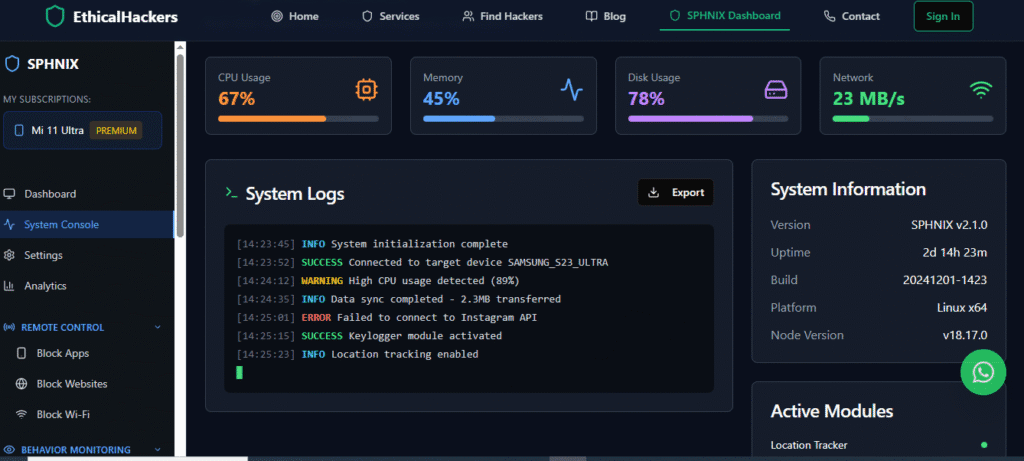
Sphnix operates as a comprehensive data aggregation tool. By integrating with iCloud credentials, it pulls synced data into a single dashboard, offering a broad view of device activity without needing to physically handle the phone after initial credential entry.
Key Features:
- Access to iCloud-synced photos, contacts, and notes.
- Location tracking via Find My iPhone data.
- Review of calendar events and backups.
- Monitoring of some social media notifications synced to iCloud.
2. mSpy
mSpy is a leader in the consumer monitoring space and offers a robust iCloud solution. It is designed for ease of use, providing a clear interface that categorizes data extracted from the target iCloud account, from messages (if iCloud Backup is on) to browsing history.

Key Features:
- iCloud backup extraction for messages (SMS, iMessage) and call logs.
- GPS location tracking with history.
- Monitoring of installed apps and screen time.
- Keylogger functionality for some data types.
3. Parentaler
Parentaler is built with a child-safety-first approach. Its iCloud monitoring focuses on giving parents peace of mind through location tracking and activity overviews, emphasizing protection over stealth.
Key Features:
- Real-time location tracking and geofencing alerts.
- Access to iCloud-synced photos and contacts.
- Social media activity reports based on available data.
- Panic alert system for the child.
The Severe Legal and Criminal Risks of True Hacking Attempts
Pursuing actual remote hacking iPhone methods is a direct path to severe consequences. Beyond the technical impossibility for most, the intent itself is criminal.
- Violation of the Computer Fraud and Abuse Act (CFAA): In the U.S., unauthorized access to any computer system, including a smartphone, is a federal crime with penalties including imprisonment.
- State-Level Cybercrime Laws: Nearly every state has its own laws against unauthorized computer access, data theft, and electronic surveillance.
- Civil Liability: You can be sued for invasion of privacy, intentional infliction of emotional distress, and other torts, leading to substantial financial judgments against you.
The Anatomy of a “Remote iPhone Hack” Scam
Understanding the scam protects your wallet and your own security. Here’s what typically happens:
- The Offer: A website claims to offer “100% undetectable remote iPhone hacking” with just a phone number.
- The Hook: You pay an initial fee (often in cryptocurrency or gift cards).
- The Upsell: You are told the “hack” is in progress but requires an additional “premium” fee to complete, or a “refundable deposit.”
- The Disappearance: After payment, communication stops, or you receive a useless file. The website vanishes. You are left with less money and a potentially compromised computer from any “tools” you downloaded.
How to Build an Impenetrable Defense for Your iPhone
Since true remote hacking is rare, focus on blocking the legal monitoring method: securing your iCloud account.
- Enable Two-Factor Authentication (2FA): This is non-negotiable. Go to Settings > [Your Name] > Password & Security. With 2FA, even if someone has your password, they cannot sign in without access to your trusted device or number.
- Use a Strong, Unique Apple ID Password: Never reuse this password elsewhere. Consider a passphrase.
- Review Your Trusted Devices: Regularly check the list of devices associated with your Apple ID and remove any you don’t recognize.
- Manage iCloud Backups: Know what data you are syncing. In iCloud Settings, you can choose what to back up. Be aware that disabling backups for Messages, for example, would limit the data monitoring apps can access.
- Beware of Phishing: Never enter your Apple ID credentials on any webpage linked from an email or text. Always go directly to apple.com.
Conclusion: Embracing Ethical and Effective Practices
The quest for a remote hacking iPhone solution is, for the overwhelming majority, a chase for a phantom that leads only to financial loss and legal risk. The practical and legal reality is that oversight is possible through iCloud-based tools when you have the proper authority. True security expertise lies in understanding these boundaries, respecting privacy, and using technology not for intrusion, but for protection and ethical investigation.
When faced with threats that legitimate software cannot address—such as advanced cyberstalking, corporate intellectual property theft, or investigating a serious personal compromise—the correct action is to engage professionals who operate within strict legal and ethical frameworks.
<a href=”https://spywizards.com” class=”cta-button” style=”display: block; width: fit-content; margin: 30px auto; padding: 15px 30px; background-color: #dc3545; color: white; text-decoration: none; border-radius: 5px; font-weight: bold; text-align: center; font-size: 1.1em;”>Hire a Hacker for Professional, Ethical Assistance</a>
Frequently Asked Questions (FAQs)
Q1: Can someone hack my iPhone remotely just by sending me a text or iMessage?
A: While “zero-click” exploits via iMessage have existed and are highly sophisticated, they are extremely rare, valued in the millions, and are quickly patched by Apple. The average person is not a target for such attacks. The real risk from texts is phishing—clicking a link that takes you to a fake login page.
Q2: If I use an iCloud monitoring app as a parent, will it alert the iPhone user?
A: Typically, no. These apps work by passively accessing iCloud data; they do not install an app on the iPhone itself. However, if the target user checks their Apple ID account page, they may see the location of the device accessing the data (often a server location, not clearly identifiable as monitoring software). Good practice is to be transparent with children about safety monitoring.
Q3: What is the single most important step to prevent any form of iPhone hacking?
A: Without question, enable Two-Factor Authentication (2FA) for your Apple ID. This adds a critical layer of security that makes unauthorized access via password theft or monitoring software incredibly difficult, as it requires physical access to a trusted device or number to approve the login.