How to Spy on My Wife’s Phone: The Complex Reality of Spousal Phone Monitoring
In my decade of experience in digital forensics and relationship investigation cases, I’ve witnessed the profound pain and suspicion that leads someone to search for how to spy on my wife’s phone. The emotional turmoil is real—the sleepless nights, the gut feelings that something is wrong, the need for certainty. As someone who has worked with private investigators, lawyers, and directly with individuals in crisis, I understand the desperation that fuels this search.
Updated February 2026
However, I must begin with a direct and critical warning: In nearly all jurisdictions, installing monitoring software on another adult’s phone without their explicit knowledge and consent is illegal. It violates wiretapping, computer fraud, and privacy laws. You could face criminal charges, civil lawsuits, and the evidence you gather would likely be inadmissible in court. This article is not a guide to illegal activity. Instead, it is a professional examination of why people consider this path, the technical realities of what is possible, the severe legal boundaries, and the ethical alternatives for addressing relationship concerns. Sometimes, the hardest truth to face is that spying isn’t the solution to a broken trust.
The Legal Landscape: Why Consent is Non-Negotiable
Before examining a single method, you must understand the legal framework. Laws vary by location, but general principles are consistent.
- The Computer Fraud and Abuse Act (CFAA) in the U.S. makes unauthorized access to a computer system (including a smartphone) a federal crime.
- State-level wiretapping laws typically require two-party consent for recording communications. Secretly intercepting text messages, calls, or emails violates these statutes.
- Expectation of Privacy: Courts generally recognize that individuals have a reasonable expectation of privacy in their personal communications, even from a spouse.
The only common legal exception is monitoring a device you own and have provided to your spouse, where you have a clear, written policy stating it may be monitored for specific purposes (like a company phone). Secretly spying on a personal device is a legal minefield.
Understanding the Technical Methods: What “Spying” Actually Involves
The phrase “spy on my wife’s phone” typically refers to one of three technical approaches, each with different requirements and limitations.
1. Direct Physical Access and Manual Checking:
This is the simplest method but offers no ongoing surveillance and carries high risk of discovery. It involves manually scrolling through messages, emails, and apps when the phone is unlocked and unattended. It provides only a snapshot in time and if discovered, will almost certainly destroy trust and escalate conflict.
2. Commercial Monitoring Software (The Most Discussed Method):
These are applications that, once installed on the target phone, relay data (messages, calls, GPS location, app activity) to a private online dashboard. This is what most people envision when they think of spying.
- The Critical Requirement: One-time physical access to the target phone is almost always needed for installation, which takes 5-10 minutes.
- The Stealth Factor: Quality apps run invisibly, with no icon, and minimal battery impact.
- The Legal Reality: Installing them without consent is the illegal act.
3. Network-Based Interception (Highly Complex and Illegal):
This involves setting up tools to intercept data as it travels over Wi-Fi networks. It is extremely technically complex, easily detectable by security professionals, and unambiguously illegal for private citizens. It is not a practical or safe option.
Review of Monitoring Applications: Capabilities and Considerations
If you are in a jurisdiction where you have legal standing (consult a lawyer first), or you are evaluating options for a device you own, here is an analysis of leading software. This is for informational purposes only.
1. Sphnix Tracking App: Comprehensive Covert Monitoring
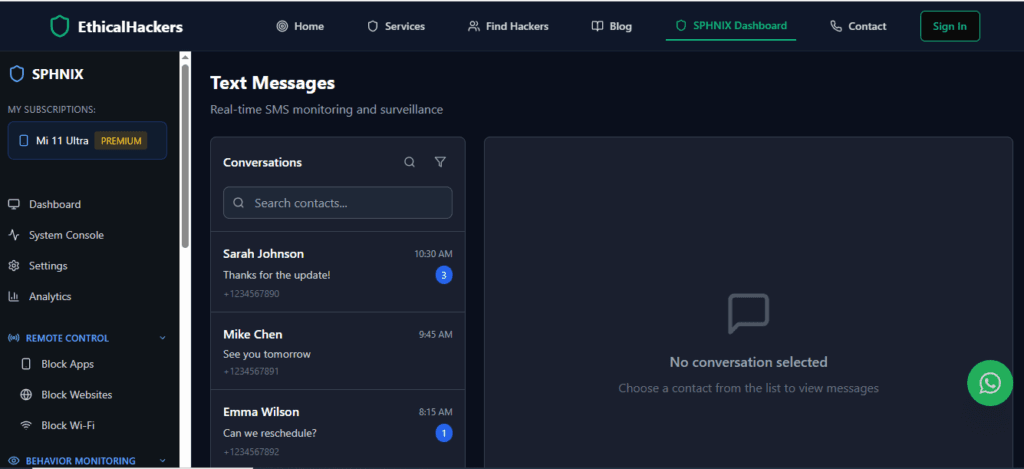
Sphnix is designed for deep, undetected surveillance, providing a full picture of device activity.
- Key Features for Spousal Monitoring:
- Call & Text Logging: Records all calls and SMS/iMessage content with timestamps.
- Social Media & Chat App Tracking: Monitors WhatsApp, Facebook Messenger, Instagram, Snapchat, Tinder, and more.
- Real-Time GPS Location: Tracks movement with history and geofencing alerts.
- Ambient Recording: Can remotely activate the microphone to listen to surroundings.
- Keylogger: Captures every keystroke typed, revealing search terms and login attempts.
- Consideration: Sphnix offers one of the most extensive feature sets, which also means it provides an overwhelming amount of data that can be painful to sift through.
2. Scannero: Location-Focused Intelligence
Scannero takes a different approach. It’s primarily a global phone number tracker that can provide crucial circumstantial evidence without full device access.
- Key Features for Investigative Insight:
- Cell Phone Location Tracking: Provides the approximate location of a phone number via cell tower triangulation.
- SMS Sending for Verification: Can send a crafted SMS to the target phone, which could be used as part of a strategy to gauge reactions or create opportunities for conversation.
- Number Lookup Services: Provides carrier and registration data.
- Consideration: Scannero doesn’t show messages or call content. It answers the question “Where is this phone?” not “What is being said on it?” It can be a less invasive first step to confirm or allay suspicions about movements.
3. Moniterro: All-in-One Monitoring and Control
Moniterro is a robust suite that combines tracking with remote control features, offering both insight and intervention capabilities.
- Key Features for Spousal Monitoring:
- Full Social Media & Call Monitoring: Similar depth to Sphnix for communications.
- Remote Device Control: Features may include locking the phone, wiping data, or blocking specific apps and contacts.
- Environment Capture: Can secretly take pictures or record video using the phone’s cameras.
- App Activity & Usage Reports: Shows which apps are used most and when.
- Consideration: The remote control features are powerful but, if used without consent, could constitute additional computer intrusion offenses.
The Professional and Ethical Alternative: Private Investigation
If your suspicions are severe enough to consider illegal spying, there is a better path: hire a licensed private investigator (PI).
- How It Works: A PI operates within the law. They can conduct lawful surveillance (physical and sometimes digital), perform background checks, and gather admissible evidence through legal means.
- The Advantages: Evidence is collected legally, protecting you from prosecution. It is often more comprehensive (combining digital clues with real-world observation). It provides professional, objective analysis rather than your own emotionally charged interpretation of data.
- The Cost: This is more expensive than DIY software but is the only method that keeps you on the right side of the law.
Before You Spy: Confronting the Real Issue
The technical “how-to” is only half the story. The more important question is: Should you?
- What is Your Goal? Is it to confirm infidelity for a divorce? To ease your own anxiety? To control your partner? The goal dictates the method and its consequences.
- Can You Handle What You Find? Discovering evidence of betrayal is devastating. It also forces an immediate, painful confrontation. Be prepared for the emotional aftermath.
- Have You Tried Direct Communication? Often, the healthier first step is a difficult, honest conversation, possibly with the help of a couples therapist. Spying preemptively destroys any possibility of rebuilding trust through communication.
Conclusion: Choosing Between Surveillance and Sanity
The search for how to spy on my wife’s phone is a symptom of a deeper relationship crisis. While technology like Sphnix, Scannero, and Moniterro provides the technical capability for covert monitoring, using it without consent is illegal and often escalates conflict in destructive ways.
If your concerns are serious, the most prudent course is to either pursue open communication or engage a professional—a lawyer to understand your rights, a therapist to navigate the relationship issues, or a licensed private investigator to gather legal evidence. The path of secret spying rarely leads to peace of mind; it more often leads to legal trouble and confirmed heartbreak without the tools to process it healthily.
If you are facing profound relationship doubts and believe evidence is necessary, it is crucial to act within legal boundaries. The risks of illegal spying are too great. For a confidential discussion about professional, ethical investigation options that protect you from legal liability, consider consulting with our expert team.
Frequently Asked Questions (FAQs)
Q1: Will my wife get a notification if I install monitoring software on her phone?
High-quality apps like Sphnix or Moniterro are designed to be undetectable. They do not send notifications, the icon is hidden, and they use minimal battery. However, if she regularly checks her phone’s list of installed applications or uses sophisticated security software, there is a small chance of discovery.
Q2: Is it legal if I own the phone and pay the bill?
This is a common misconception. Ownership of the device and payment of the bill do not automatically grant you the legal right to secretly intercept the private communications of another adult using that device. The legal test often revolves around the user’s reasonable expectation of privacy. You should always consult with an attorney in your jurisdiction. The safest legal position requires informed consent.
Q3: What’s the difference between using an app and hiring a private investigator?
The key difference is legality and methodology. You using an app likely constitutes illegal computer access. A licensed private investigator is bound by state laws and uses legal methods such as database research, physical surveillance, and legally obtained records. Their evidence is admissible in court, while illegally obtained spy data is not and could result in charges against you.