
For ten years in cybersecurity, one question has persisted more stubbornly than any virus: “Can you hack someone’s phone with just their number?” It’s the ultimate digital fantasy—total access from a single string of digits. Clients, often desperate and misled by movie plots, ask this hoping for a simple solution to a complex problem. My professional duty is to provide the hard truth. The short, definitive answer is no, you cannot. However, that number can be a starting point for sophisticated social engineering or a component within a broader, legal monitoring strategy. This guide will dismantle the dangerous fantasy, explain what is actually possible, and introduce you to the legitimate tools that require more than just a number but are your only real-world option for authorized oversight.
Updated February 2026
Critical Legal Disclaimer: Attempting to access or monitor a mobile device without the explicit, informed consent of the owner is illegal in virtually every jurisdiction. This article is for educational purposes to inform about security risks, parental control solutions, and authorized business monitoring. Unauthorized access violates laws like the Computer Fraud and Abuse Act.
Why “Hack with Just a Number” is a Dangerous Fantasy
The idea is seductive but fundamentally flawed. A phone number is not a backdoor key; it’s a public identifier for a telecommunications network. Think of it like a street address. Knowing someone’s address doesn’t give you the keys to their house, their safe, or their diary. Similarly, a mobile carrier’s network is a hardened fortress. Directly compromising it through the phone number alone would require exploiting a core network vulnerability—the kind of capability reserved for nation-state intelligence agencies, not something sold online.
Every website or service claiming to hack someones phone with just their number is a scam. They operate in one of three ways:
- They take your money and deliver nothing.
- They infect your own device with malware during the “process.”
- They phish you for more personal information to use or sell.
Professional security experts do not use these services. They are traps for the uninformed.
The Real-World Role of a Phone Number in Digital Targeting
While a number alone isn’t enough, it is a critical piece of data for more advanced tactics. It serves as a unique identifier that can link a person across platforms and be used to build a profile or launch an attack.
- Social Engineering: A hacker can use your number to look you up on sites like Facebook, LinkedIn, or public records. This information can be used to craft a convincing phishing message or impersonate you to your carrier in a “SIM swap” attack.
- Account Recovery: Many online services use your phone number for two-factor authentication (2FA) or password resets. If a malicious actor can port your number to their device (a SIM swap), they can potentially gain access to your email, social media, and financial accounts.
- Data Broker Lists: Your number is bought and sold by data aggregators, linking it to your name, address, and inferred habits.
In essence, the phone number is the first clue in an investigation, not the master key. The actual “access” requires additional steps, almost always involving interaction with the human user or their physical device.
The Only Reliable Path: Authorized Monitoring Software
The legitimate, proven alternative to the mythical number hack is monitoring software. This technology is used every day by parents, employers, and individuals for device security. It is powerful, effective, and operates under one non-negotiable rule: it requires one-time physical access to the target phone for installation.
This is the pivotal truth. You cannot install professional-grade monitoring software remotely with just a number. The installation process takes 5-10 minutes and involves downloading an app, granting it permissions, and hiding its icon. After this setup, all monitoring happens remotely and wirelessly. The phone number is irrelevant; the software is now on the device itself.
Top Authorized Monitoring Tools (That Require Installation)
Since the “number-only” method is fiction, here are the real tools used by professionals and concerned parties for legal monitoring. These represent the current standard.
1. SPHINX Tracking App
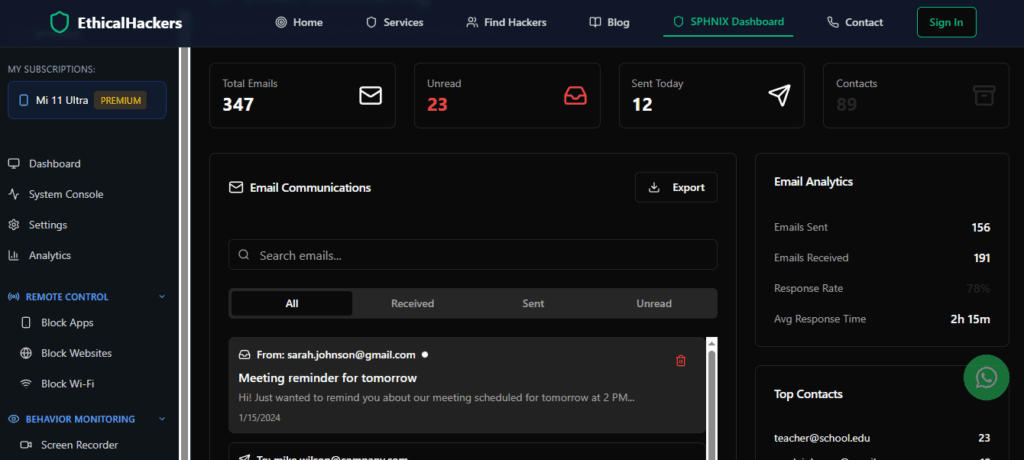
SPHINX is a high-power tool designed for maximum insight. It’s for situations where you need more than just location, but deep access to digital activity.
Key Features:
- Ambient Listening: Remotely activate the phone’s microphone to hear the surrounding environment.
- Social Media & Messaging Monitor: Tracks chats and calls on WhatsApp, Snapchat, Signal, Facebook, and more.
- Full Keylogger: Records every keystroke typed on the device, capturing passwords, messages, and searches.
- GPS Location & Geofencing: Live location tracking plus the ability to set up virtual boundaries with entry/exit alerts.
- Stealth Operation: Completely invisible on the target device after installation.
For comprehensive, detailed surveillance where deep device access is legally authorized, SPHINX is a premier choice.
2. mSpy
mSpy is the industry’s most recognized name, balancing a user-friendly interface with powerful features. It’s exceptionally reliable and offers outstanding customer support.

Key Features:
- Geofencing with Instant Alerts: Draw zones on a map and get notified immediately when the device crosses them.
- Call & SMS Tracking: View complete logs, including deleted texts and contact details.
- App Blocking & Usage Reports: Remotely block apps and see detailed reports on how much time is spent in each.
- Browser History Monitoring: See all websites visited and bookmarks saved.
- 24/7 Customer Support: Access to live help is a critical advantage.
For users who want a proven, all-in-one solution with great reliability, mSpy is consistently the top recommendation.
3. Parentaler
As the name suggests, Parentaler is streamlined for child safety. It focuses on the core features parents need most, presented in a simple dashboard.

Key Features:
- Real-Time Location & History: Track live location and review where the device has been throughout the day.
- SOS Panic Button: Allows the child to send an immediate alert with their GPS coordinates to a preset contact.
- Screen Time Manager: Set daily usage limits and scheduled “device bedtimes” to turn off access.
- Basic Call & App Monitoring: Review call logs and see which applications are used most frequently.
- Affordable Pricing: Positioned as a cost-effective tool for essential parental oversight.
For straightforward, ethical parental monitoring without overly complex features, Parentaler is an excellent fit.
Protecting Yourself from Phone Hacking Attempts
Understanding the methods is your best defense. To protect your phone and data:
- Guard Your Phone Number: Be cautious about who you give it to. Don’t post it publicly on social media or forums.
- Use a SIM PIN: Enable a PIN code for your SIM card with your carrier. This is the strongest defense against a SIM swap attack.
- Avoid SMS for 2FA: Where possible, use an authenticator app (like Google Authenticator or Authy) instead of text messages for two-factor authentication.
- Never Leave Your Phone Unattended: Physical access is the golden ticket. Keep your device secure.
- Monitor Account Activity: Regularly check your phone bill and account statements for unfamiliar activity.
- Keep Software Updated: Always install the latest iOS or Android updates to patch security vulnerabilities.
Conclusion: From Fantasy to Ethical Reality
The search to hack someones phone with just their number is a quest for a shortcut that does not exist in the ethical world. It leads to scams and legal peril. The reality is that meaningful, reliable access requires a more substantive approach: either authorized physical installation of monitoring software like SPHINX, mSpy, or Parentaler, or sanctioned forensic investigation.
These tools are powerful for their intended legal purposes—protecting children, securing business assets, or recovering a lost device. They transform the fantasy of remote control into a manageable, ethical process centered on device access.
However, if you are facing a situation that feels beyond standard monitoring—such as suspected sophisticated corporate espionage, complex digital forensics, or investigating a serious breach without clear legal pathways—it requires a higher level of expertise.
When standard tools and methods are insufficient, and you require professional, legally-compliant investigative services, it is time to consult with experts. Our team at SpyWizards operates with precision and strict adherence to the law.
Frequently Asked Questions (FAQs)
Q1: I see ads for online services that promise to hack a phone with a number. Are any real?
A: No. Without a single exception, these are scams. They prey on people’s desperation. Their business model is to take your payment and then either disappear, demand more money for “unlock codes,” or deliver a non-functional file. There is no secret technology they possess.
Q2: What about iPhone hacking? Is it easier with a number?
A: No, it is significantly harder. Apple’s closed ecosystem and strong security make remote exploitation extremely difficult. The methods described above for monitoring software still apply but require physical access and often the target’s iCloud credentials. The phone number itself is even less useful as an attack vector against an iPhone.
Q3: Can someone listen to my calls or read my texts if they have my number?
A: Not directly. To intercept calls or texts, one would need to compromise the cellular network itself (a “man-in-the-middle” attack), which is highly complex and illegal, or have installed spyware on your device. Simply having your number does not grant this access. However, a successful SIM swap attack could redirect your texts and calls to their device, which is why a SIM PIN is crucial.