
Over my ten-year career in digital forensics, I’ve witnessed the evolution of secure messaging, with WhatsApp becoming a primary channel for private conversations. Consequently, the question of how to hack someone’s whatsapp without access to their phone has become one of the most frequent and misunderstood inquiries I receive. Clients often believe there must be a secret vulnerability or a piece of software that can bypass WhatsApp’s famous end-to-end encryption remotely. As a professional, my first duty is to deliver the unvarnished truth: direct, remote server-side hacking of an active WhatsApp account is, for all practical public purposes, impossible. However, within very narrow and strictly legal boundaries, there are methods to monitor WhatsApp activity. This guide will dismantle the dangerous scams, explain the actual technology behind WhatsApp’s security, and outline the only realistic—and legal—approaches to gaining insight into someone’s WhatsApp usage.
Updated February 2026
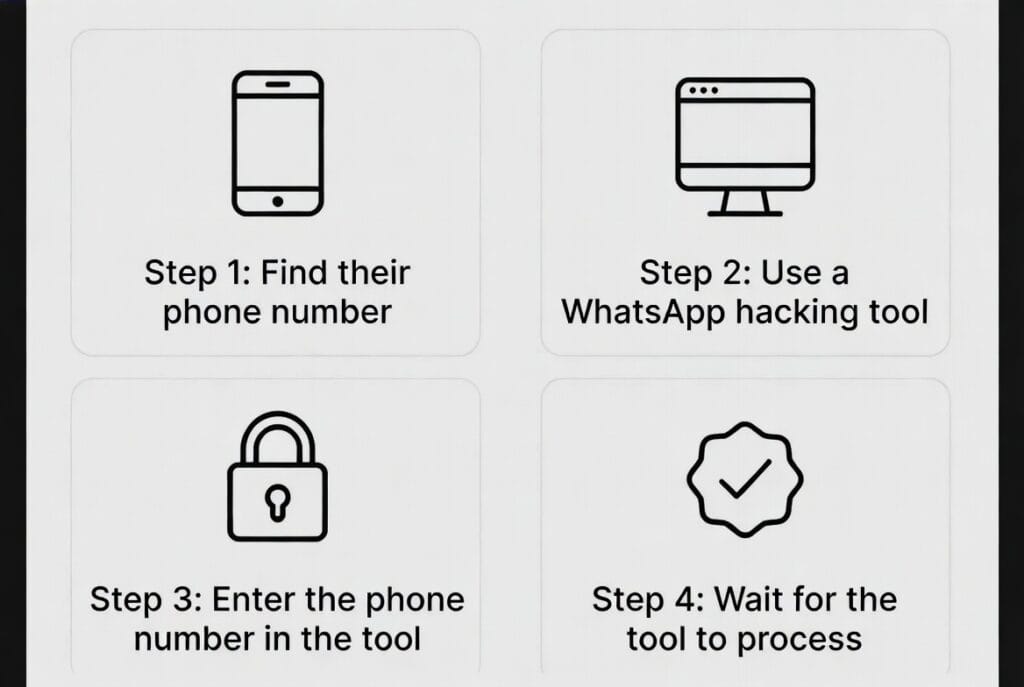
Critical Legal Disclaimer: Accessing someone else’s WhatsApp account or messages without their explicit, informed consent is illegal in most countries, violating computer fraud and privacy laws. This article discusses concepts for educational purposes and legal monitoring scenarios only, such as parental control of minors or monitoring company-owned devices with transparent consent. Unauthorized access is a crime.
The Impossible Dream: Why True Remote Hacking is a Fantasy
Your search for a way to hack someones whatsapp without access to their phone has likely led you to a plethora of scams. These frauds are engineered to exploit desperation, not provide solutions. They typically manifest as:
- Web-Based “WhatsApp Hackers”: Sites claiming to generate a code or require just the target’s phone number. They steal your payment information and deliver nothing.
- Fake Verification Code Services: These claim to intercept the 6-digit WhatsApp registration code. In reality, they attempt phishing or rely on the target mistakenly giving them the code.
- Malicious APK Files: Downloads that promise modified WhatsApp versions to spy on others but instead infect your device with spyware or steal your own WhatsApp data.
WhatsApp’s end-to-end encryption is not a marketing gimmick. It is a robust cryptographic protocol where only the sender and recipient possess the keys to decrypt messages. There is no master key, and WhatsApp’s servers cannot read your messages. Any service claiming to break this encryption remotely is lying.
The Legal Foundation: When is Monitoring Permissible?
Before any technical discussion, the legal right to monitor must be established. Legitimate scenarios are narrow and well-defined:
- Parental Responsibility: Monitoring the WhatsApp activity of your minor child on a device you own and are responsible for.
- Company Device Oversight: Monitoring WhatsApp on a company-owned smartphone issued to an employee under a clear, signed acceptable use policy that permits monitoring.
- Explicit Personal Consent: Having direct, documented permission from the device’s adult owner (e.g., within a mutual agreement).
If your objective doesn’t fit within these frameworks, you are considering an illegal act. The technical “how” is irrelevant without the legal “right.”
How WhatsApp’s Security Actually Works: The Encryption Barrier
To understand why remote hacking fails, you must understand the security model. When you send a WhatsApp message, it is encrypted on your device using a unique lock (key) that only the recipient’s device possesses. The encrypted data passes through WhatsApp’s servers but remains an unreadable scramble. The recipient’s device uses its key to decrypt and display the message.
This means there is no central point of attack on WhatsApp’s servers to harvest messages. The only points where the message exists in a readable form are on the sender’s and recipient’s devices. Therefore, any effective monitoring must focus on one of these two devices.
The Professional Shift: Monitoring the Device, Not the Account
Since breaking encryption in transit is not feasible, the professional methodology shifts the target from the WhatsApp account to the physical smartphone where the app is installed and messages are decrypted for reading.
This approach acknowledges a crucial point: the phrase “without access to their phone” typically refers to not having ongoing physical possession. For effective monitoring, a one-time, brief physical installation of software on the target device is almost always the non-negotiable first step.
Authorized Method 1: Comprehensive Device Surveillance Suites
These are powerful applications that, once installed on the target device, can capture WhatsApp activity by recording what happens on the device’s screen and keyboard. They don’t break WhatsApp’s encryption; they capture the data after it has been decrypted and displayed.
How it works: The software uses granted permissions (like Accessibility Services on Android) to log screen content, keystrokes, and notifications from the WhatsApp app.
Recommended Tool: SPHINX Tracking App
SPHINX is a high-powered tool designed for deep device insight, making it effective for monitoring encrypted apps like WhatsApp.
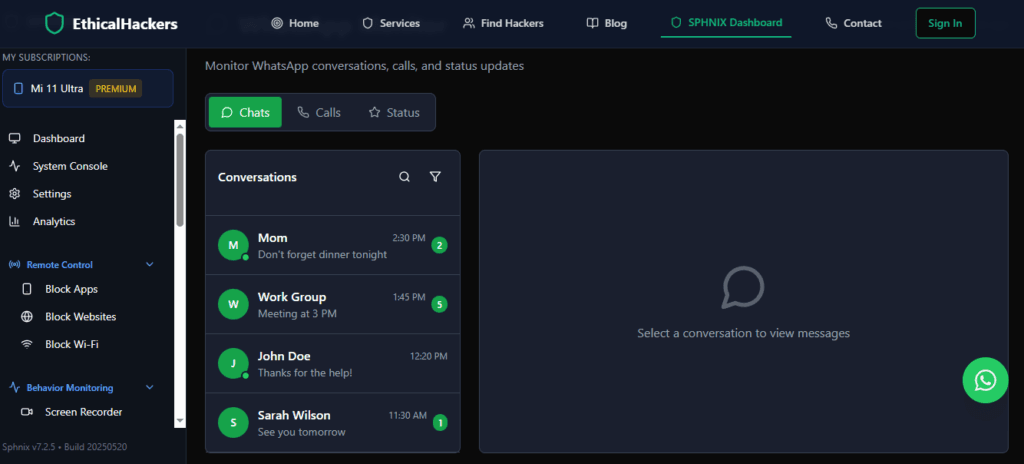
Key Features for WhatsApp Monitoring:
- Social Media & Chat Monitor: Specifically tracks messages, shared media, and call logs within the WhatsApp application.
- Keylogger Function: Records every keystroke typed, capturing message drafts and any typed passcodes.
- Screen Recording & Screenshots: Takes periodic images of the screen when WhatsApp is active.
- Notification Logging: Captaches incoming message previews from WhatsApp even if the screen is locked.
- Stealth Operation: Runs invisibly in the background with no icon or performance indicators.
Recommended Tool: mSpy
mSpy is an industry leader known for reliability and a user-friendly interface, with dedicated features for social media and chat app monitoring.

Key Features for WhatsApp Monitoring:
- Dedicated WhatsApp Tracking: Provides a clean, separate panel in the dashboard showing WhatsApp messages, timestamps, and contacts.
- Media File Access: Allows you to view photos and videos shared through WhatsApp.
- Contact Monitoring: Shows the list of WhatsApp contacts and frequency of communication.
- App Blocking Feature: Can remotely block access to the WhatsApp app if needed.
- 24/7 Support: Excellent customer service to help with setup on various devices.
Authorized Method 2: Streamlined Parental Control Platforms
For parents, the goal is often safety oversight rather than forensic-level detail. Tools like Parentaler provide a simplified view of app activity.

Recommended Tool: Parentaler
Parentaler is engineered for child safety, offering a straightforward dashboard that includes insights into messaging app use.
Key Features Relevant to WhatsApp:
- App Activity & Usage Reports: Shows how much time is spent on WhatsApp and can provide an overview of communication.
- Contact & Interaction Insights: Helps identify who your child is frequently contacting.
- Safety-Centric Design: Presents data in a way that highlights potential risks for parents.
- Integrated Location & SOS: Combines digital monitoring with physical safety features.
The Critical Installation Step: The Bridge to Remote Access
All three tools (SPHINX, mSpy, Parentaler) require an initial installation on the target device. This process takes 5-15 minutes of physical access:
- Obtain the target smartphone.
- Temporarily adjust security settings to allow installation from unknown sources (Android) or configure the device (iOS).
- Download and install the monitoring application.
- Grant the necessary permissions (Accessibility, Notification Access, etc.).
- Hide the application and configure stealth settings.
- Return the phone.
After this, monitoring is 100% remote via your web dashboard. This is the realistic answer to how to hack someones whatsapp without access to their phone on an ongoing basis—after a single, authorized installation.
How to Fortify Your Own WhatsApp Account
Understanding these methods is your best defense. To protect your WhatsApp:
- Enable Two-Step Verification: This adds a PIN to your account, making it exponentially harder for someone to register your number on a new device.
- Use Screen Lock: Set up biometric (fingerprint/face) or strong PIN lock for your device itself.
- Review Linked Devices: Regularly check “Linked Devices” in WhatsApp settings (WhatsApp Web/Desktop) and log out of any you don’t recognize.
- Never Share Your Verification Code: WhatsApp will never call you to ask for your 6-digit code. Anyone who asks for it is trying to hijack your account.
- Keep Your Phone Physical: The primary defense against monitoring software is controlling who has physical access to your device.
Conclusion: From Forbidden Intrusion to Authorized Insight
The pursuit of a method to how to hack someones whatsapp without access to their phone ultimately leads away from magical thinking and toward the reality of authorized device management. Tools like SPHINX for comprehensive surveillance, mSpy for reliable tracking, and Parentaler for parental oversight provide legal pathways when used within their intended ethical boundaries.
This process transforms an illegal fantasy into a structured, accountable action plan centered on device access and legal authority. It provides the oversight that is justified for protection and safety.
However, some situations—such as complex infidelity investigations, corporate espionage cases, or gathering legally-admissible digital evidence—require a professional grade of forensic skill and legal knowledge.
If you are dealing with a high-stakes scenario that demands professional investigative services, forensic precision, and guaranteed legal compliance, expert assistance is essential. Our team at SpyWizards operates with strict adherence to legal protocols and professional standards.
Frequently Asked Questions (FAQs)
Q1: Can I use the iCloud or Google Drive backup to read someone’s WhatsApp messages?
A: Potentially, but with major limitations. WhatsApp backups to iCloud or Google Drive are not end-to-end encrypted by default (though this is changing). If you have the target’s iCloud/Google credentials and physical access to a device to restore the backup, you could see historical messages. This is not real-time monitoring, is technically complex, and may trigger security alerts on the target’s account.
Q2: What about WhatsApp Web? Can I use that to monitor messages?
A: WhatsApp Web requires the target’s phone to be on and connected to the internet. To initially link a new browser session, you must physically scan a QR code with the target’s phone or approve the login via a notification on their phone. Without one of these actions from the target device, you cannot establish a WhatsApp Web connection. It is not a remote hacking tool.
Q3: Are there differences in monitoring WhatsApp on iPhone vs. Android?
A: Yes, significantly. Android’s more open system allows for deeper monitoring of app data and screen activity. On iOS, due to stricter sandboxing, monitoring WhatsApp typically requires the iPhone to be jailbroken for full feature access, which is a complex and detectable process. Non-jailbreak solutions for iOS are more limited and often rely on notification logging rather than direct message access.