
The search for a way to how can i read my girlfriends text messages without her phone often starts with a knot of anxiety in your stomach. The distance, the secrecy, the feeling that the person you’re closest to is suddenly a stranger—it’s a deeply unsettling experience that pushes many to seek digital shortcuts for emotional clarity. As a professional with extensive experience in digital security, I encounter this desperate search often.
Let me be direct: while certain technical pathways exist, they are gateways to serious legal trouble and personal ruin, not solutions. This guide will explain the cold technical realities of remote monitoring, the laws you would be breaking, and why the healthiest path forward never involves a spy app.
The Technical Reality of “No-Phone” Access
The phrase “without her phone” suggests a desire for completely remote, undetectable access. The technological truth is more limited and conditional. There is no magic portal that lets you peer into someone’s private messages from thin air. Instead, legitimate monitoring software relies on one of two access points, both of which have significant prerequisites.
For iPhone users, the primary method is iCloud backup extraction. Apple’s iCloud service can automatically back up a device’s data, including iMessage and SMS logs, to its servers. If you possess your girlfriend’s iCloud Apple ID and password, and she has iCloud Backups enabled for Messages, certain monitoring services can log into this account, extract the message data, and display it on a private dashboard. This process does not require ongoing physical access to the phone itself, but it does hinge on having her correct login credentials and the specific backup setting being active.
For Android phones, the landscape is far more restrictive. Android’s security model and the diversity of device manufacturers make true “no-touch” remote installation virtually non-existent for consumer-grade tools. Almost every credible monitoring solution for Android requires one-time physical access to install the application. After this initial installation, data can be viewed remotely, but that critical first step is nearly unavoidable.
The Legal Framework: You Are Considering a Crime
This is not a gray area. In the United States, Canada, the United Kingdom, Australia, and most other jurisdictions, what you are considering is unequivocally illegal. The action violates core privacy laws designed to protect individuals from exactly this kind of intrusion.
The most relevant law in the U.S. is the Electronic Communications Privacy Act (ECPA), often referred to as the “Wiretap Act.” It is a federal crime to intentionally intercept, access, or use any electronic communication without authorization. By using her iCloud credentials without permission or installing surveillance software on a device you do not own, you are committing:
- A Criminal Offense: Prosecutors can bring charges for computer fraud, identity theft (for using her credentials), or unlawful interception. This can result in fines and imprisonment.
- A Civil Violation: She can sue you for invasion of privacy, intentional infliction of emotional distress, and other torts. The financial damages awarded in such suits can be substantial.
It is crucial to understand that paying for a phone bill or being in a relationship grants you zero legal rights to secretly monitor her private communications. The only widely accepted legal uses for this technology are parents monitoring their minor children’s devices and employers monitoring company-owned equipment with explicit prior notice to employees.
Analysis of Monitoring Applications and Their Claims
The market is filled with applications that market powerful remote features. It is vital to evaluate them with the understanding that their intended legal use is parental control, and repurposing them for spousal or partner surveillance is a violation of their terms of service and the law.
| App Name | Claimed “Remote” Features | Technical & Practical Realities | Reported User Issues |
|---|---|---|---|
| Sphnix Tracking App | Promotes monitoring of texts, calls, and social media via a remote dashboard. | For iPhones, likely uses iCloud extraction. For Android, will require physical installation. Effectiveness depends entirely on correct credentials and settings. | As a lesser-known suite, independent, long-term reviews of its reliability and data security are scarce. |
| Eyezy | Markets an “iCloud syncing” feature for iMessages and SMS without jailbreaking, plus social media monitoring. | This is a classic iCloud backup extraction method. It will fail if two-factor authentication is enabled, backups are off, or credentials are incorrect. | Generally considered user-friendly but is, by design, a powerful stalkerware tool when misused. |
| Spynger | Advertises remote tracking of texts, social media, and calls with no physical access needed. | Such claims are highly suspect, especially for Android. User reviews and expert analyses frequently flag this app for not working as advertised, failing to sync data, and causing noticeable battery drain. | Widespread complaints about functionality, customer service, and difficulty canceling subscriptions. |
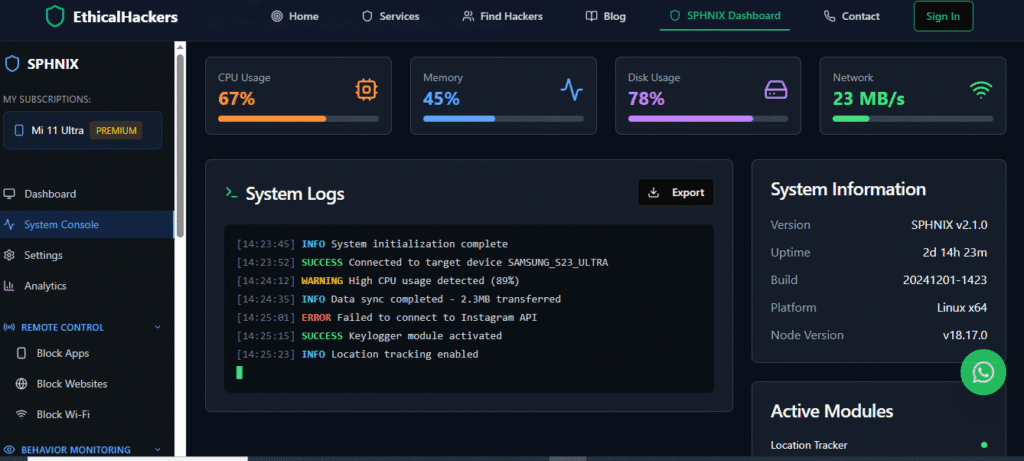
Sphnix Tracking App
Sphnix is presented as a comprehensive tracking suite. Its marketing suggests you can monitor a device’s activity from a remote online portal once set up. The critical step is that initial setup, which for any real functionality, will require either her iCloud credentials (for iPhone) or physical access (for Android).
Eyezy
Eyezy explicitly promotes an “iCloud Sync” feature, positioning it as a solution for monitoring iPhones without touching the device. This is technically accurate for the method it uses, but it creates a false sense of simplicity. It does not bypass the need for her username and password, making its use a clear case of unauthorized computer access.

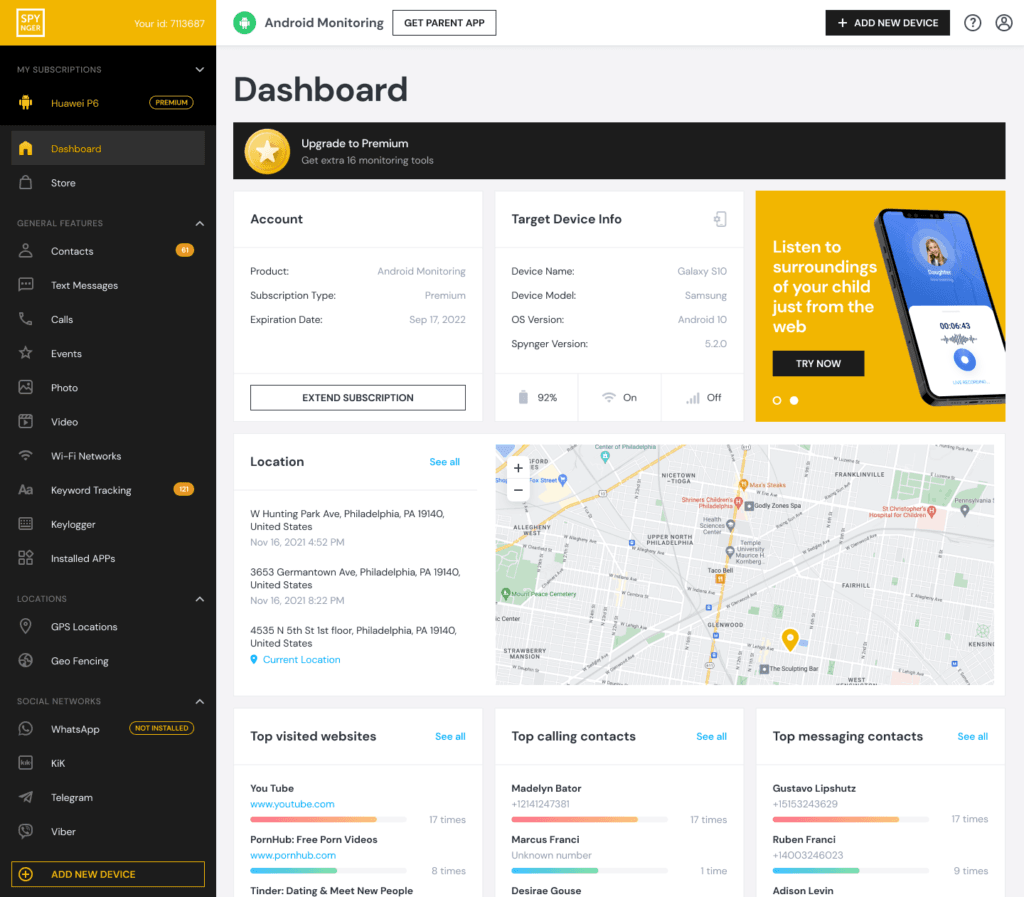
Spynger
Spynger’s marketing makes bold promises about remote access. However, independent scrutiny reveals significant problems. Beyond potential legal troubles, users risk paying for a service that may not work, could be easily detected due to poor coding (like rapid battery drain), and might embroil them in subscription scams.
The Inevitable Personal and Relational Fallout
Beyond the courtroom, the personal consequences of this choice are devastating and permanent. Secret surveillance is an act of profound betrayal that obliterates the foundation of a relationship.
- You Become the Untrustworthy One: If discovered, the entire narrative flips. The problem is no longer her secretive behavior; it becomes your calculated deception. You will be seen as controlling, manipulative, and dangerous.
- You Guarantee the Relationship’s End: Trust, once broken in this fundamental way, is nearly impossible to rebuild. The relationship will almost certainly end in a storm of anger, hurt, and legal proceedings.
- You Sacrifice Your Own Integrity: Living with a secret of this magnitude is corrosive. It will change how you see yourself, trapping you in a cycle of paranoia and guilt as you check the dashboard, looking for evidence to justify your own bad actions.
The Right Path: Addressing Suspicion Without Surveillance
The burning desire to read your girlfriend’s text messages without her phone is a symptom of a relationship in crisis. Treating this symptom with spyware only worsens the disease. Here are constructive, adult ways to address the root cause:
- Practice Direct Communication: Summon the courage for a vulnerable, honest conversation. Use “I feel” statements: “I’ve been feeling really insecure and disconnected lately. I miss our closeness. Is there a time we can talk about what’s going on with us?” This focuses on your feelings and the relationship, not accusations.
- Seek Professional Relationship Counseling: A licensed therapist provides a neutral, structured environment for both partners to express fears, improve communication, and explore issues—including infidelity—with expert guidance. This is the single healthiest step a troubled couple can take.
- Evaluate the Relationship Honestly: Sometimes, the lack of trust is a signal that the relationship itself is no longer healthy. If you cannot believe her without resorting to espionage, it may be time to consider a separation, pursued with dignity and legal advice, not criminal surveillance.
Conclusion
The technical methods to access someone’s messages remotely, as used by apps like Sphnix, Eyezy, and Spynger, do exist. However, employing these tools to read your girlfriend’s text messages without her phone is not a clever solution; it is a serious federal crime and an act of profound personal betrayal that will destroy everything you are trying to hold onto.
True peace of mind can never be found in a secret dashboard. It is built through honesty, courage, and communication. Choose the harder but honorable path: face the issue directly through conversation or counseling, or find the strength to walk away. Your future self—one not facing criminal charges or living with the guilt of having become a spy—will thank you.
For expert consultation on digital security, understanding privacy laws, or conducting ethical investigations within strict legal boundaries, professional services are available.
Frequently Asked Questions (FAQs)
1. If she uses an iPad linked to her iPhone, can I read the messages there?
Technically, iMessages often sync across Apple devices logged into the same iCloud account. However, accessing her iPad to read these messages without her permission is still a violation of her privacy and potentially illegal. Ownership of a shared device does not automatically grant the right to snoop through private communications stored on it.
2. What about using a “backup extractor” tool on a computer she syncs her phone to?
These forensic tools exist, but they almost always require the phone to be physically connected to the computer to extract data. Furthermore, using such a tool on a device you do not own to extract private data is a clear-cut case of unauthorized access and computer fraud.
3. Is it legal if I suspect she’s cheating?
No. The legal system does not recognize personal suspicion as a defense for breaking computer fraud and privacy laws. A police officer or judge will not accept “I thought she was cheating” as a justification for hacking her iCloud account or installing spyware. Your suspicion may be valid, but your proposed method of confirmation is criminal.