The iMessage Access Question: A Professional Reality Check
In my ten years of specializing in Apple ecosystem security and digital forensics, I’ve learned that few topics generate as much confusion as iMessage access. The desire on how to log into someone’s iMessages often stems from genuine concern—a parent worried about a child’s safety, or someone investigating a serious breach of trust. However, the phrase “log in” creates a dangerous misunderstanding. iMessage isn’t a service you log into from a web browser like email; it’s an encrypted protocol tied to a specific Apple ID and device. This guide will correct that misunderstanding, explain the stark legal boundaries, and detail the only technically viable methods for authorized iMessage monitoring. If you’re seeking clarity in a landscape filled with scams, you’re in the right place.
Updated February 2026
Critical Legal Disclaimer: Accessing someone else’s iMessage account or conversations without their explicit, informed consent is a federal crime under the Computer Fraud and Abuse Act and state-level privacy laws. This information is for educational purposes and legal use cases only: parental control of minors or monitoring a company-owned Apple device with transparent employee consent. Unauthorized access is illegal.
The Legal Imperative: Why “Logging In” is the Wrong Mindset
Before any technical discussion, we must address the legal and ethical framework. The idea of “logging in” implies you have credentials and permission. Without that permission, you are considering a criminal act.
Legitimate scenarios for monitoring iMessages are narrow:
- Parental Responsibility: You are the parent or legal guardian of a minor child and need to oversee their communications on a device you own and manage.
- Company Device Management: The iPhone or iPad is company property, issued to an employee under a signed agreement that explicitly states the device and its communications may be monitored for security and compliance.
- Explicit Personal Consent: You have the direct, documented permission of the device’s adult owner (e.g., within a mutual agreement in a partnership).
If your situation does not fit one of these categories, you cannot proceed legally. The technical methods for how to log into someone’s imessages are irrelevant without this foundational right.
Understanding iMessage’s Architecture: Why It’s Not a Simple Login
iMessage is not a standalone web service. It’s a deeply integrated, encrypted communication protocol within Apple’s ecosystem. Key security features make unauthorized access extremely difficult:
- End-to-End Encryption: Messages are encrypted on the sender’s device and only decrypted on the recipient’s device. Apple does not possess a key to decrypt them in transit or on its servers.
- Apple ID & Device Binding: Your iMessage identity is your Apple ID. This account is protected by a password and, critically, two-factor authentication (2FA). Even with the correct password, logging into the Apple ID on a new device requires approval from a trusted device or a trusted phone number.
- The Trusted Device Chain: When you set up a new iPhone, Mac, or iPad for iMessage, you must approve that device from an already trusted device. This creates a chain of trust that prevents remote, unauthorized logins.
Therefore, the concept of simply “logging in” from a remote location with just a password is functionally impossible if the target has 2FA enabled—which they absolutely should.
Debunking the Remote “iMessage Login” Scams
Your search for a way to log into someone’s iMessages has undoubtedly led you to fraudulent services. These scams are prolific and prey on this specific misunderstanding. They typically operate by:
- Phishing for Apple ID Credentials: Creating fake Apple login pages to steal usernames and passwords.
- Selling “iMessage Spyware” That Doesn’t Exist: Offering software that claims to hack iMessage remotely. It is always fake, often contains malware, and is designed to steal your money.
- Promoting “Verification Code” Interception Services: Claiming they can intercept the 2FA code sent via SMS. This is extremely difficult and not a service sold publicly.
Professional investigators do not use these methods. They are criminal traps.
The Authorized Method 1: Device-Based Monitoring with Jailbreak
The only method for real-time, comprehensive iMessage monitoring requires a specific technical condition: the target iPhone must be jailbroken. Jailbreaking removes Apple’s software restrictions, allowing the installation of monitoring software that can access the iMessage database directly.
This method does not involve “logging in” to the iMessage account. Instead, it involves installing software on the device that reads the messages after they have been decrypted and stored locally.
The Process:
- Jailbreak the iPhone: Use a current, stable tool compatible with the device’s iOS version (e.g., unc0ver, palera1n). This voids the warranty and carries risks.
- Install Monitoring Software: Through the jailbreak’s package manager, install a specialized monitoring application.
- Configure Remotely: The software sends iMessage data to a secure web dashboard.
Recommended Tool: Sphnix Tracking App
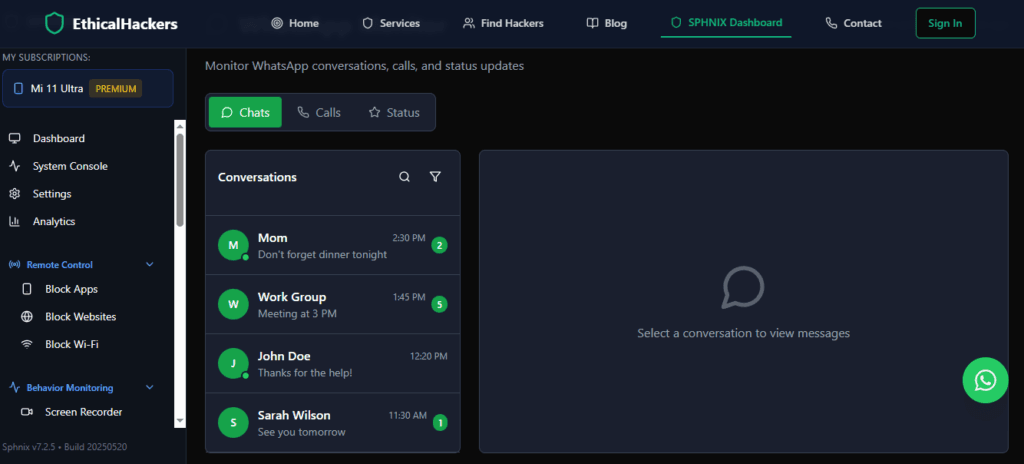
Sphnix is a high-powered surveillance suite designed for deep access on jailbroken devices.
Key Features for iMessage Monitoring:
- Direct iMessage Database Access: Logs all iMessage conversations (text, images, reactions) in real-time.
- Deleted Message Capture: Can often retrieve iMessages deleted from the thread.
- Media Extraction: Automatically saves photos, videos, and files shared via iMessage.
- Advanced Stealth: Includes features to help hide the jailbreak and the monitoring app itself.
Recommended Tool: mSpy
mSpy offers a robust solution for jailbroken iPhones, providing a user-friendly dashboard for iMessage monitoring.

Key Features for iMessage Monitoring:
- Comprehensive iMessage Logging: Captures full conversations, including timestamps and contact information.
- Media Access: Views shared photos and videos within the dashboard.
- User-Friendly Interface: Presents iMessage data in a clean, chat-style format.
- 24/7 Support: Provides expert assistance for the jailbreak and installation process.
The Authorized Method 2: iCloud Backup Extraction (Non-Real-Time)
If jailbreaking is not an option, there is a limited, non-real-time method. This requires having the target’s Apple ID username and password.
How it works: If the target has iCloud Backups enabled and has chosen to include Messages in the backup, you can use their credentials to access the iCloud backup file. This backup contains a snapshot of their iMessage history up to the point of the last backup.
Critical Limitations:
- Not Real-Time: You only see historical messages, not new ones as they arrive.
- Requires Credentials and Often Disabled 2FA: You need the Apple ID password. Two-factor authentication is a major hurdle and disabling it will alert the user.
- Technical Extraction Required: Simply having the credentials doesn’t present the messages in a readable format; you need a tool or service to parse the backup data.
Recommended Tool: Parentaler
Parentaler, while often simpler and focused on parental controls, may utilize iCloud backup extraction as part of its methodology for providing insights into a child’s message history when direct installation isn’t possible or desired.

Key Features Relevant to Message Access:
- Data Overview: Can provide access to message history from iCloud backups.
- Safety-Focused Reporting: Presents communication data in a way designed for parental review.
- Lower Technical Barrier: Avoids the complex jailbreak process.
Step-by-Step: The Realistic Path for Authorized Access
For the jailbreak method (Sphnix, mSpy), the process is involved:
- Establish Legal Right: Confirm you are in a legal use case.
- Obtain Physical Device: You must have the iPhone in hand.
- Jailbreak: Research and execute a jailbreak compatible with the device’s iOS version.
- Install Monitoring App: Use the jailbreak’s package manager to install the chosen software.
- Configure & Hide: Set up the dashboard and enable stealth settings.
- Return Device & Monitor Remotely: All future iMessage data is sent to your private online dashboard.
For the iCloud method, the process is credential-based and does not require physical possession, but has the severe limitations noted.
How to Protect Your Own iMessages
Understanding these methods is your best defense:
- Enable Two-Factor Authentication: This is the single most important step. It makes Apple ID credential theft alone insufficient for account access.
- Use a Strong, Unique Apple ID Password: Never reuse this password elsewhere.
- Review Trusted Devices: Regularly check the list of trusted devices in your Apple ID settings and remove any you don’t recognize.
- Avoid Jailbreaking Your Device: It compromises security fundamentally.
- Manage iCloud Backups: Be aware that messages in iCloud Backup are a potential data source if someone has your credentials.
Conclusion: From Login Fantasy to Authorized Oversight
The quest to understand how to log into someone’s imessages must evolve from a fantasy of remote account access to a reality of authorized device monitoring or forensic data extraction. Tools like Sphnix and mSpy (with jailbreak) provide real-time access, while methods leveraging iCloud credentials offer a historical, non-real-time alternative.
Neither is a simple “login.” Both require significant technical steps and, most importantly, a clear legal and ethical right to proceed. This process respects the strength of Apple’s security while providing a pathway for legitimate oversight.
For situations that extend beyond these methods—such as formal legal investigations, recovering data from a locked or damaged device, or dealing with highly sophisticated targets—professional forensic tools and expertise are required.
If you are facing a complex, high-stakes situation that demands professional investigative services, forensic-grade evidence collection, and strict legal compliance, expert assistance is crucial. Our team at SpyWizards operates within the boundaries of the law to provide such specialized solutions.
Frequently Asked Questions (FAQs)
Q1: Can I see someone’s iMessages if I know their Apple ID password?
A: Not directly, and not in real-time. With their password, you might be able to access their iCloud backup (if Messages are included) to see a historical snapshot. However, if they have two-factor authentication (2FA) enabled—which they should—you cannot approve the login on a new device without access to one of their trusted devices or phone numbers. Simply having the password is often not enough.
Q2: Is it possible to monitor iMessages without jailbreaking the iPhone?
A: Real-time, direct monitoring of iMessages is not possible without a jailbreak due to iOS sandboxing. The only non-jailbreak alternative is the iCloud backup extraction method, which is not real-time and has significant prerequisites and limitations.
Q3: If I use the iCloud method, will the target get a notification?
A: Yes, it is highly likely. If you log into their Apple ID from a new device or browser, and they have 2FA enabled, they will receive an alert on their trusted devices. If you attempt to disable 2FA, that action itself may also generate a notification. The iCloud method carries a high risk of alerting the user.