
If you find yourself wondering how to check your spouse’s text messages for free, you’re likely in a place of deep emotional turmoil. That gnawing suspicion, the quiet dread, the desperate search for a “quick fix” to confirm or deny your fears is something I’ve encountered countless times in my decade of digital forensics and cybersecurity work. Let’s be clear from the start: the internet is filled with dangerous promises, but the path to real answers is paved with legal, technical, and ethical realities you must understand.

This guide will cut through the noise, explaining what is genuinely possible, the significant risks involved, and why the healthiest resolution to your doubts rarely involves secret surveillance.
The Critical Legal and Ethical Line You Must Not Cross
Before discussing any method, you must understand the legal framework. In most jurisdictions, including under laws like the Computer Fraud and Abuse Act in the United States, installing monitoring software on another adult’s phone without their explicit, informed consent is a crime. It can be prosecuted as computer fraud or invasion of privacy.
Your marital status does not override this law. A spouse has a reasonable expectation of privacy on their personal device. Violating this privacy can not only destroy your relationship but also expose you to civil lawsuits or even criminal charges. Ethically, trust is the cornerstone of a marriage. Secret surveillance replaces partnership with espionage, creating a dynamic of control and deceit that is nearly impossible to repair.
How Phone Monitoring Technology Actually Works
To make an informed decision, it’s essential to separate marketing hype from technical reality. The apps that can monitor text messages fall into two broad categories: visible parental control apps and hidden monitoring apps.
- Visible Apps: These require consent and appear on the device’s home screen. They are typically limited to basic functions like screen time management and location sharing.
- Hidden Apps: These are designed to operate in stealth mode, making them invisible to the device user. This is the category of apps often misused for spying on a partner. They require an initial installation, which almost always necessitates physical access to your spouse’s phone for at least several minutes.
The common promise of “free” monitoring is a major red flag. As noted by industry sources, free tracking apps are often designed to steal your personal information or the information of the person you’re trying to monitor. Professional-grade monitoring requires infrastructure and development, which is why legitimate services operate on a paid subscription model.
Detailed Analysis of Monitoring Applications
Let’s examine the specific apps you’ve asked about. The following table compares their core attributes to provide a clear overview before we explore each one in detail.
mSpy: The Extensive Monitoring Suite
mSpy is one of the most well-known apps in this space, heavily marketed for parental oversight. Its sheer number of features is its main selling point.

- Core Text & Social Media Monitoring: It logs SMS, iMessages, and conversations across a vast array of platforms including WhatsApp, Facebook Messenger, Snapchat, Instagram, Telegram, and more.
- Advanced Surveillance Tools: Beyond texts, mSpy includes a keylogger (capturing every keystroke), a screen recorder that takes periodic screenshots of the device, and detailed GPS tracking with geofencing alerts.
- How It Works: It requires either physical installation on the target device or, for iPhones, the user’s iCloud credentials.
- Important Notes: Independent reviews highlight that mSpy “leans more heavily on the surveillance features” and can feel intrusive. Testing has shown that some social media monitoring features may not work consistently, and installation on modern iPhones can be particularly challenging.
Sphnix Tracking App
Sphnix is promoted as a discreet surveillance solution.
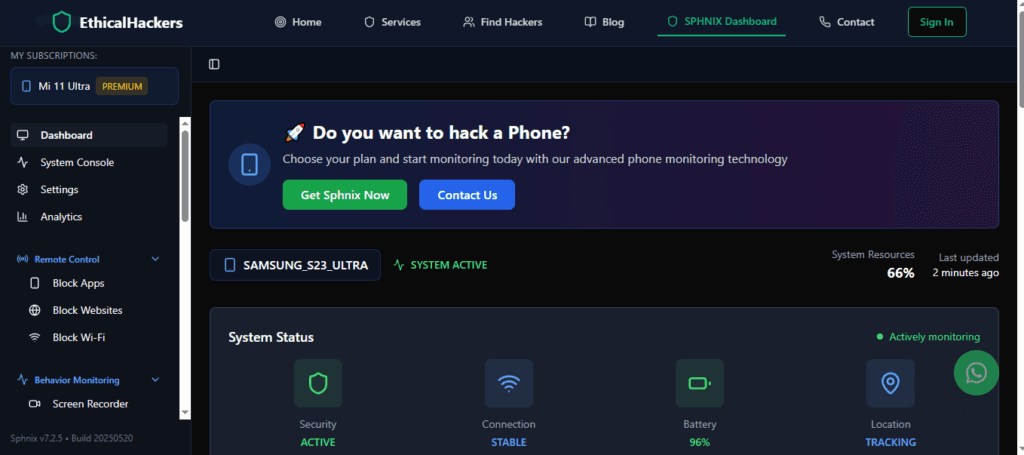
- Reported Capabilities: While detailed public specifications are scarcer, tools in this category typically advertise the ability to monitor text messages (SMS), call logs, social media apps, and GPS location, all while running in a hidden mode.
- The Reality: Using an app like Sphnix to secretly monitor a spouse would constitute a severe legal violation. Its operation would almost certainly require physical access to the target phone for installation.
Parentaler
Parentaler is explicitly named and designed as a parental control application.

- Intended Features: Its legitimate use involves monitoring a child’s text and social media messages for safety, tracking their location, filtering web content, and managing healthy screen time habits.
- The Critical Misuse: Employing Parentaler to check your spouse’s text messages for free (or at any cost) is a fundamental abuse of the software. It violates the app’s purpose, your partner’s trust, and potentially the law.
The Severe Risks and Consequences of Secret Spying
Choosing to install spyware carries devastating potential outcomes that extend far beyond your relationship.
- Legal Repercussions: As stated, you risk criminal prosecution and civil liability. A moment of suspicion could lead to a permanent criminal record.
- Total Relationship Collapse: If discovered—and these apps can be found—this betrayal often destroys any remaining trust irrevocably. The relationship typically ends in the most painful way possible.
- Financial and Security Scams: The “free spy app” ecosystem is a breeding ground for fraud. You are highly likely to encounter malware, phishing sites, or software that simply steals your payment information.
- Emotional and Moral Damage: Living with this secret creates constant anxiety and guilt. It can erode your own self-respect and trap you in a cycle of obsessive checking, not resolution.
The Healthier Path: From Surveillance to Resolution
If your suspicions are strong enough to make you consider illegal surveillance, your marriage has a foundational crisis of trust. Technology cannot fix this human problem; it will only cause more damage. Here is a more constructive and courageous path:
- Self-Reflection: Honestly examine the source of your doubt. Is it based on specific, observable changes in behavior, or is it fueled by your own insecurities or past experiences?
- Direct, Honest Communication: This is the most difficult but only healthy step. Choose a calm, private time. Use “I feel” statements: “I’ve been feeling disconnected and worried about us lately. I’m carrying some fears, and I need to talk about it because I value our marriage.”
- Seek Professional Help: A licensed marriage counselor can provide a neutral, guided space to facilitate this critical conversation and address the underlying issues of trust and communication.
- Evaluate with Integrity: If the trust is so broken that secret spying seems like the only option, it may be time to honestly assess the relationship’s future. It is braver to confront that reality directly than to poison it with surveillance.
When Professional Cybersecurity Services Are Actually Appropriate
You may wonder about services like SpyWizards. As a professional ethical hacking firm, we operate in a completely different, legal, and ethical realm. We provide authorized services such as:
- Digital Forensics: Legally recovering data from devices you own for court-sanctioned investigations.
- Security Audits & Defense: Helping individuals and businesses secure their devices against unauthorized spyware and hacking.
- Incident Response: Assisting victims of cyberstalking to safely identify and remove malicious software.
We defend privacy and security; we do not violate it for personal suspicions. If you believe you are being monitored, those are the services that can lawfully help you.
Conclusion: Choose Honesty, Not Surveillance
The search for a way to check your spouse’s text messages for free is a quest for a technological shortcut around profound relational pain. The shortcuts are illegal, unethical, and dangerous. Apps like mSpy, Sphnix, and Parentaler are built for specific contexts—primarily parental oversight—and twisting them into instruments for marital surveillance is an abuse that often backfires catastrophically.
True peace of mind comes from clarity, not covert access. That clarity is achieved through painful honesty, professional help, or the difficult decision to part ways with integrity. Invest your energy in the path that allows you to look at your reflection with respect. That is the only foundation for a secure future, whether your marriage is part of it or not.
Frequently Asked Questions (FAQs)
Q1: What if I’m just worried about my spouse’s safety or financial decisions?
Genuine safety or financial concerns are addressed through partnership, not surveillance. Have an open conversation from a place of care and shared responsibility: “I’m our family’s security and finances lately. Can we sit down and review things together so we’re both on the same page?”
Q2: If we share a phone plan or I own the device, doesn’t that give me the right?
No, it does not. Ownership of a physical device or payment of a service plan does not grant legal authority to secretly monitor the private communications of another adult using that device. The right to privacy is personal.
Q3: What are the signs that my own phone might have spyware on it?
Be alert to sudden, unexplained changes: very rapid battery drain, the device feeling warm when idle, unusual lag or slow performance, unexpected spikes in mobile data usage, or the phone restarting on its own. If you suspect you are a victim, consult a cybersecurity professional.