

In my decade of digital forensics and cybersecurity practice, I’ve encountered every conceivable question about message monitoring. But one query persists above all others, representing the holy grail of digital surveillance: Can we hack WhatsApp without victim mobile in hand? This question embodies the ultimate fantasy of remote, undetectable access. Clients ask this hoping for a technological magic trick that bypasses the fundamental security of the world’s most popular messaging app. As a professional, I must begin with a critical clarification: the term “hack” is misleading. True, unauthorized server intrusion is impossible for the public. However, the question of monitoring WhatsApp without sustained physical possession has a more nuanced answer that revolves around legal authority and a single, brief point of contact with the device. This guide will dissect the technical landscape, separate persistent myths from limited realities, and explain the exact methods professionals use when authorized to monitor WhatsApp activity.
Updated February 2026
Related WhatsApp guide: For readers comparing WhatsApp-specific risks, our guide to how WhatsApp monitoring works legally explains account recovery, linked-device checks, and safe app options.

Critical Legal Disclaimer: Attempting to access someone’s WhatsApp without their explicit, informed consent is illegal in most countries. This article discusses technological concepts and tools for strictly legal purposes: parental control of minors, monitoring company-owned devices with employee consent, or accessing your own property. Unauthorized access violates computer fraud and privacy laws.
Understanding WhatsApp’s Security: The Encryption Barrier
To address whether you can we hack WhatsApp without victim mobile, you must first understand what you’re up against. WhatsApp employs end-to-end encryption by default. This isn’t just a feature; it’s a fundamental architecture. When a message is sent, it’s encrypted on the sender’s device and only decrypted on the recipient’s device. The encrypted data passes through WhatsApp’s servers, but the company cannot read it. There is no master key.
This design means there is no central server vulnerability to exploit for message extraction. The only points where messages exist in a readable form are on the two endpoint devices. Therefore, any effective method must ultimately target one of these devices, not the network or account in the cloud.
The “No-Touch” Hacking Myth and Its Dangers
The internet is flooded with fraudulent services claiming to offer exactly what this question asks. They are universally scams. These include:
- Web-Based “WhatsApp Hackers”: Sites that ask for a phone number and promise to deliver messages. They steal payment information and personal data.
- Fake Verification Code Services: These claim to intercept the 6-digit registration SMS. They are phishing operations designed to trick you into giving them the code from the target’s phone.
- Malicious APK Files: Downloads that claim to be modified WhatsApp versions with “spy features.” They install malware on your device, compromising your own data and accounts.
Professional investigators do not use these services. They are criminal traps. The fantasy of a remote, instant hack with just a number is exactly that—a fantasy.
The Legal Framework: Permission Precedes Technology
Before any technical discussion, the legal right is paramount. You can only pursue monitoring if you fall into a legitimate category:
- Parental Duty: You are monitoring the device of your minor child.
- Business Asset Management: The smartphone is company property, issued under a policy that explicitly states it may be monitored.
- Explicit Personal Consent: You have the direct, documented permission of the device’s adult owner.
If your goal doesn’t fit here, you are considering a crime. The technical “how” is irrelevant without the legal “why.”
The Professional Methodology: The Single-Point Installation
The most effective and reliable method for monitoring WhatsApp involves specialized software installed on the target device. This shifts the paradigm from “hacking without the mobile” to “monitoring after a one-time installation.”
The critical nuance is this: you do not need ongoing access. You need a single window of 5-10 minutes of physical access to install the software. After installation, the phone is returned, and all monitoring happens remotely via a web dashboard. This is how professionals bridge the gap between the desire for remote access and the need for a physical starting point.
Authorized Monitoring Tool 1: Sphnix Tracking App
Sphnix is a high-powered surveillance suite designed for deep device insight. It is particularly effective for monitoring encrypted applications because it captures data at the device level.
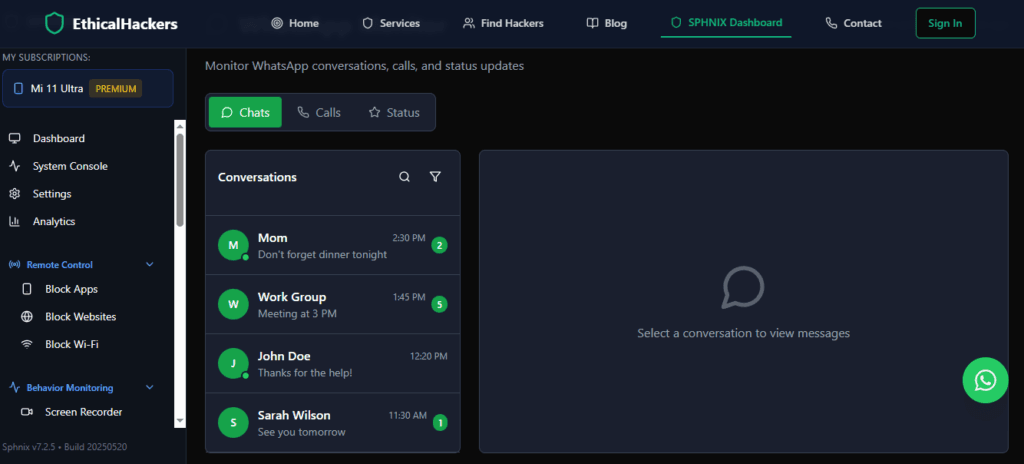
How it Monitors WhatsApp:
Once installed, Sphnix uses granted system permissions to log activity within the WhatsApp application, including screen content and keystrokes.
Key Features for WhatsApp:
- Complete Message Logging: Captures sent and received WhatsApp messages, including group chats, with accurate timestamps.
- Media Access: Views photos, videos, and voice notes shared within chats.
- Call Logging: Records metadata for WhatsApp voice and video calls.
- Keylogger Function: Captures every keystroke, including message drafts and search terms.
- Advanced Stealth: Operates with no icon and leaves minimal system footprint.
Authorized Monitoring Tool 2: mSpy
mSpy is an industry leader known for its reliability, user-friendly interface, and excellent customer support. It provides dedicated features for social media and chat app monitoring.

How it Monitors WhatsApp:
mSpy’s software extracts data from the WhatsApp application on the device and presents it in a clean, organized dashboard.
Key Features for WhatsApp:
- Dedicated WhatsApp Panel: Displays messages in an easy-to-read chat interface within the control panel.
- Multimedia File Access: Allows you to view shared photos, videos, and documents.
- Contact Monitoring: Shows the list of WhatsApp contacts and communication frequency.
- App Blocking Feature: Can remotely block access to the WhatsApp app if necessary.
- 24/7 Support: Provides expert help for setup and troubleshooting.
Authorized Monitoring Tool 3: Parentaler
Parentaler is streamlined for parental control, focusing on child safety with a simplified dashboard. It provides oversight of app usage, including WhatsApp.

How it Monitors WhatsApp:
Parentaler typically accesses app data and notifications to provide parents with insights into their child’s WhatsApp activity.
Key Features for WhatsApp:
- App Activity Overview: Shows how much time is spent on WhatsApp and provides insights into communication patterns.
- Safety-Centric Insights: Highlights potential risks and concerning contacts.
- Integrated Safety Tools: Combines app monitoring with real-time GPS location and an SOS panic button.
- Simplified Interface: Designed for parents who need clear information without technical complexity.
The Limited “No-Installation” Scenario: Cloud Backups
There is one scenario that loosely fits the idea of accessing WhatsApp without victim mobile in hand, but it has severe limitations. If the target user has enabled WhatsApp backups to iCloud (iOS) or Google Drive (Android), and you have their cloud account credentials (Apple ID/Google password), you could potentially restore their backup to another device to see past messages.
Critical Limitations:
- Not Real-Time: You only see messages from the last backup, which could be days old.
- Credential Requirement: You need their cloud username and password.
- Security Alerts: This may trigger two-factor authentication (2FA) alerts on their device.
- Technical Hurdle: The process of restoring a backup to a different device is not simple and may require resetting the second device.
This method is brittle, not real-time, and legally precarious without consent. It is not a substitute for active monitoring.
How to Secure Your WhatsApp Against Monitoring
Understanding these methods is your best defense:
- Enable Two-Step Verification: In WhatsApp Settings > Account, add a 6-digit PIN. This prevents someone from registering your number on a new device even if they have your SMS verification code.
- Use Biometric App Lock: Enable fingerprint or face ID lock for WhatsApp within the app’s privacy settings.
- Disable Cloud Backups: If maximum security is your goal, turn off iCloud/Google Drive backups for WhatsApp. Without a backup, there is no secondary data source.
- Review Linked Devices: Regularly check “Linked Devices” in WhatsApp settings and log out of any unfamiliar computers or browsers.
- Guard Your Primary Device: The strongest defense is physical security. Use a strong device passcode and never leave your phone unlocked and unattended.
Conclusion: Bridging the Gap Between Desire and Reality
The question can we hack WhatsApp without victim mobile reveals a desire for a solution that doesn’t exist in the realm of ethical, legal monitoring. The realistic pathway involves authorized use of professional tools like Sphnix, mSpy, or Parentaler after a single, brief installation. Cloud backup extraction offers a fragile, non-real-time alternative with significant prerequisites.
True power lies not in mythical remote exploits but in understanding and correctly applying the technology that exists within legal boundaries. These tools provide robust oversight for protection and safety when used responsibly.
However, certain complex situations—formal legal investigations, corporate espionage, or cases involving sophisticated technical countermeasures—require a level of expertise beyond consumer software.
If you are facing a serious situation that demands professional investigative services, forensic-grade analysis, and guaranteed legal compliance, expert intervention is necessary. Our team at SpyWizards operates within strict ethical and legal frameworks to provide specialized solutions for complex digital challenges.
Frequently Asked Questions (FAQs)
Q1: If I have the target’s iCloud/Google password, can I see their live WhatsApp messages?
A: No. Cloud credentials only give access to backups, not live data. You would see message history up to the point of the last backup. To see live messages, you would need to constantly restore new backups, which is impractical and would likely alert the user. Live monitoring requires software on the device.
Q2: Can monitoring software be installed remotely via a link or message?
A: No, not on modern, updated smartphones. Operating systems like iOS and Android have strict security measures that prevent the silent, remote installation of apps. Installation requires deliberate user action to enable “Install from Unknown Sources” (Android) or requires physical interaction with the device. Phishing links can trick a user into installing malware, but that requires the victim to click and approve installation—it’s not a silent remote hack.
Q3: Does WhatsApp notify the user if their messages are being monitored by such apps?
A: WhatsApp itself does not send a notification. However, if the monitoring software is poorly designed or configured, it might cause noticeable battery drain or performance issues. High-quality, stealth-focused apps like those reviewed are designed to avoid detection. The user would not receive a direct alert from WhatsApp saying they are being monitored.
Leave a Reply