
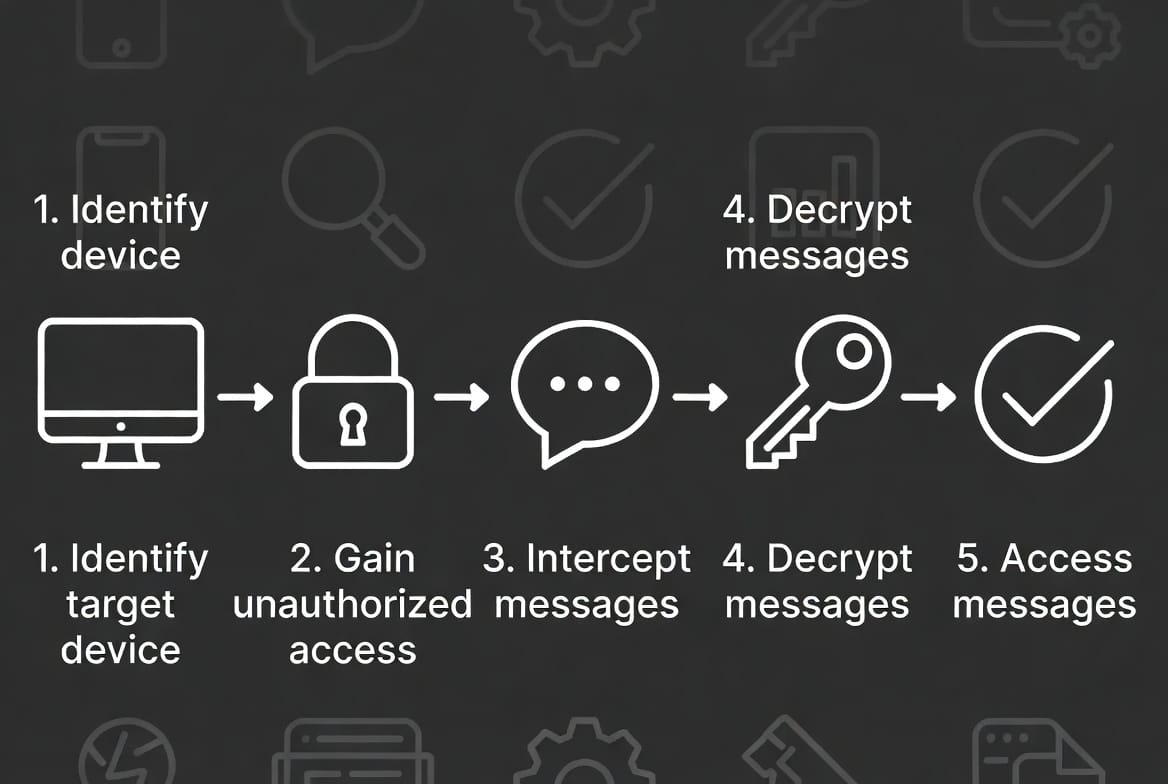
In my decade of work in digital forensics and ethical security consulting, I’ve learned that the request to access someone’s private messages is rarely about Hollywood-style “hacking.” It’s usually driven by tangible fear, suspicion, or a duty of care. When clients ask me how to hack into someone’s messages, they’re often misusing the word “hack.” What they truly seek is a way to monitor communications for protection or truth-seeking, but they’ve been led astray by dangerous online myths. The stark professional reality is that breaking into encrypted servers is fantasy for the public. However, authorized monitoring of the device where messages are read is a proven, reliable process. This guide will replace fiction with fact, outline the strict legal framework, and detail the exact technical methods used in legitimate investigations for accessing messages.

Critical Legal Disclaimer: Unauthorized access to someone else’s private messages (SMS, social media, email) is a crime under laws like the Computer Fraud and Abuse Act. This article discusses concepts and tools for legal purposes only: parental control of minors, monitoring company-owned devices with employee consent, or accessing your own property. Never monitor without explicit permission.
The “Remote Message Hacker” Scam: Your First Hurdle
Your search for information on how to hack into someones messages has already exposed you to a vast criminal industry. These scams are engineered to exploit your need, not fulfill it.
- Fake “Message Spy” Services: Websites selling software that claims to access Facebook, WhatsApp, or iMessage with just a username. They take your payment and vanish.
- Phishing Kits Disguised as Tools: These pretend to be hacking apps but instead steal your login credentials or install malware on your own computer.
- Impossible Promises: Any service claiming to provide real-time messages from a phone number alone is lying. It violates the basic security architecture of cellular and internet networks.
Professional investigators do not use these services. They are frauds. The real methodology is more procedural and hinges on authorized access.
The Legal Gateway: When Do You Have a Right to Know?
The technical “how” is irrelevant without the legal “if.” You must have a clear right to monitor. Legitimate justifications are specific:
- Parental Responsibility: You are monitoring the smartphone of your minor child.
- Business Asset Protection: The device is company property, issued under a policy that clearly states it may be monitored for security and productivity.
- Explicit Personal Consent: You have the direct, documented permission of the device’s adult owner (e.g., mutual agreement in a partnership).
If your goal doesn’t fit here, you are planning a crime. This is the non-negotiable first step in any professional approach.
The Technical Principle: Target the Device, Not the Cloud
Modern messaging apps (iMessage, WhatsApp, Signal) use end-to-end encryption. This means messages are scrambled between the sender and receiver’s devices. Servers cannot read them. Therefore, the only consistent point for monitoring is the physical device where messages are decrypted and displayed.
Professional monitoring software doesn’t break the encryption. It is installed on the target device and records what happens on the screen and keyboard. This shifts the objective from the impossible (breaking server encryption) to the manageable (capturing data on the endpoint).
Method 1: Comprehensive Device Surveillance
This method uses powerful software that provides deep access to all device activity, including messages across multiple platforms. It’s for situations requiring full visibility.
How it Works: Software is installed on the target phone. It uses system-level permissions to log message content from SMS and social apps, keystrokes, and even screen activity.
Recommended Tool: SPHINX Tracking App
SPHINX is a high-powered suite for deep device insight and is particularly effective for accessing messages across various platforms.

Key Features for Message Access:
- Social Media & Messaging Monitor: Captures conversations from WhatsApp, Facebook Messenger, Signal, Snapchat, and SMS/iMessage.
- Keylogger: Records every keystroke, capturing message drafts and passwords.
- Screen Recording/Screenshots: Takes images of the screen when messaging apps are active.
- Ambient Listening: Can remotely activate the microphone, potentially capturing voice messages or calls.
- Stealth Operation: Once installed, it is invisible on the device, with no icon or performance drain.
Method 2: Forensic Data Extraction
Sometimes, you need to analyze existing message history rather than monitor live. This is common in investigative contexts where you need to see past conversations stored on a device.
How it Works: These tools extract data stored locally on the device’s memory, such as cached messages, app data files, and database remnants.
Recommended Tool: Scannero
Scannero specializes in data extraction and forensic analysis, making it useful for building a historical record of messages.

Key Features for Message Access:
- Data Recovery: Extracts cached message databases and app data from the device’s storage.
- App-Specific Parsing: Can often parse data from popular messaging apps to reconstruct conversations.
- Report Generation: Creates organized reports of extracted communications.
- Cross-Platform Support: Works on various devices to retrieve stored information.
Method 3: Integrated Dashboard Monitoring
For ongoing oversight, especially in parental or business contexts, a unified dashboard that combines message access with other device data provides the most complete picture.
How it Works: This software provides continuous monitoring, sending message data from the target device to a live web dashboard alongside location, call logs, and app usage.
Recommended Tool: Moniterro
Moniterro offers an all-in-one monitoring approach, with message tracking as one component of a broader oversight system.

Key Features for Message Access:
- Unified Message Inbox: Aggregates SMS and social app messages into a single, chronological feed.
- Contextual Monitoring: Shows messages alongside the device’s location and other app activity at the time.
- Usage Analytics: Tracks how much time is spent in different messaging apps.
- Alert Systems: Can be configured to flag messages containing specific keywords.
- Holistic Dashboard: Provides a single-pane view of all device activity.
The Inescapable Requirement: The Installation Barrier
All effective methods share one absolute requirement: initial physical access to the target device. There is no professional, reliable software that bypasses this step. The installation window is brief (5-15 minutes) but crucial. It involves:
- Temporarily disabling security protections.
- Installing the monitoring application.
- Granting extensive permissions.
- Hiding the application.
After this, the device is returned. All message monitoring occurs remotely via your private dashboard. This is the realistic cornerstone of any plan on how to hack into someones messages for legal purposes.
How to Fortify Your Own Messages Against Access
Understanding these methods is your best defense:
- Use Fully Encrypted Apps: Signal is the gold standard. Use WhatsApp’s “end-to-end encrypted” chats (verify the lock icon) and Telegram’s “Secret Chats.”
- Enable All Security Features: Use two-factor authentication (2FA) on every account, especially your Apple ID/Google account and social media.
- Maintain Physical Control: A strong, alphanumeric device passcode is your primary barrier. Never leave your phone unlocked and unattended.
- Audit App Permissions: Regularly check which apps have Accessibility, Notification Access, or “Draw Over Other Apps” permissions (especially on Android). Revoke any that seem suspicious.
- Update Everything: Keep your phone’s OS and all apps updated to patch security vulnerabilities.
Conclusion: From Illicit Intrusion to Authorized Oversight
The journey to understand how to hack into someones messages ethically leads to a clear destination: authorized device monitoring using professional tools like SPHINX for depth, Scannero for forensics, or Moniterro for integrated oversight. These are the legitimate instruments for protection and investigation.
The process is not a magical hack but a structured technical procedure bounded by law. It provides a powerful tool for those with a genuine right to know, transforming anxiety into actionable information.
However, some scenarios—complex legal disputes, corporate investigations, or situations involving sophisticated technical obfuscation—require a level of expertise beyond consumer software.
If you are navigating a high-stakes situation that demands professional investigative services, forensic rigor, and guaranteed legal compliance, expert intervention is necessary. Our team at SpyWizards operates within the strictest legal and ethical frameworks to provide clarity and solutions.
Frequently Asked Questions (FAQs)
Q1: Can I access messages if I only have the target’s Apple ID or Google password?
A: This can provide limited, non-real-time access. For iPhones, if iCloud Backups for Messages are on, you could restore a backup to another device to see past messages. This is not live monitoring, may trigger alerts, and fails if 2FA is enabled. For Android, it is not a reliable method. It does not equate to installing dedicated monitoring software.
Q2: What’s the difference between monitoring SMS and monitoring apps like WhatsApp?
A: Monitoring standard SMS is technically simpler for software, as it accesses the phone’s native messaging database. Monitoring encrypted apps like WhatsApp is more challenging; software typically captures them via screen recording or notification logging since it cannot break the app’s encryption. The content may be captured, but the method is less direct.
Q3: Is it easier to monitor messages on Android or iPhone?
A: Android is generally less restricted, allowing direct installation of monitoring apps from outside the Play Store. iOS has a closed ecosystem; full monitoring without limitations usually requires jailbreaking the iPhone, which is a significant technical step, voids warranties, and makes the device less secure. Non-jailbreak iOS solutions exist but are more limited.
